
September 14, 2026
The Life We Receive, Not Achieve
Teaching by Chris Berglund | Notes by Leah Ramirez | The Gathering, Colorado Springs
There is a profound difference between trying to live the Christian life and learning to live from the life of Christ.
Many believers love Jesus deeply, believe the Gospel sincerely, and genuinely desire holiness, maturity, and obedience. Yet underneath all of that devotion there can still be an exhausting assumption: I have to become what God is asking me to be.
We try harder. We attempt to become more spiritual. We become more disciplined. We work to get ourselves into the right condition and produce the right fruit.
But what if the New Testament begins somewhere else?
What if the Gospel does not first announce a better religious system, but an entirely different order of life?
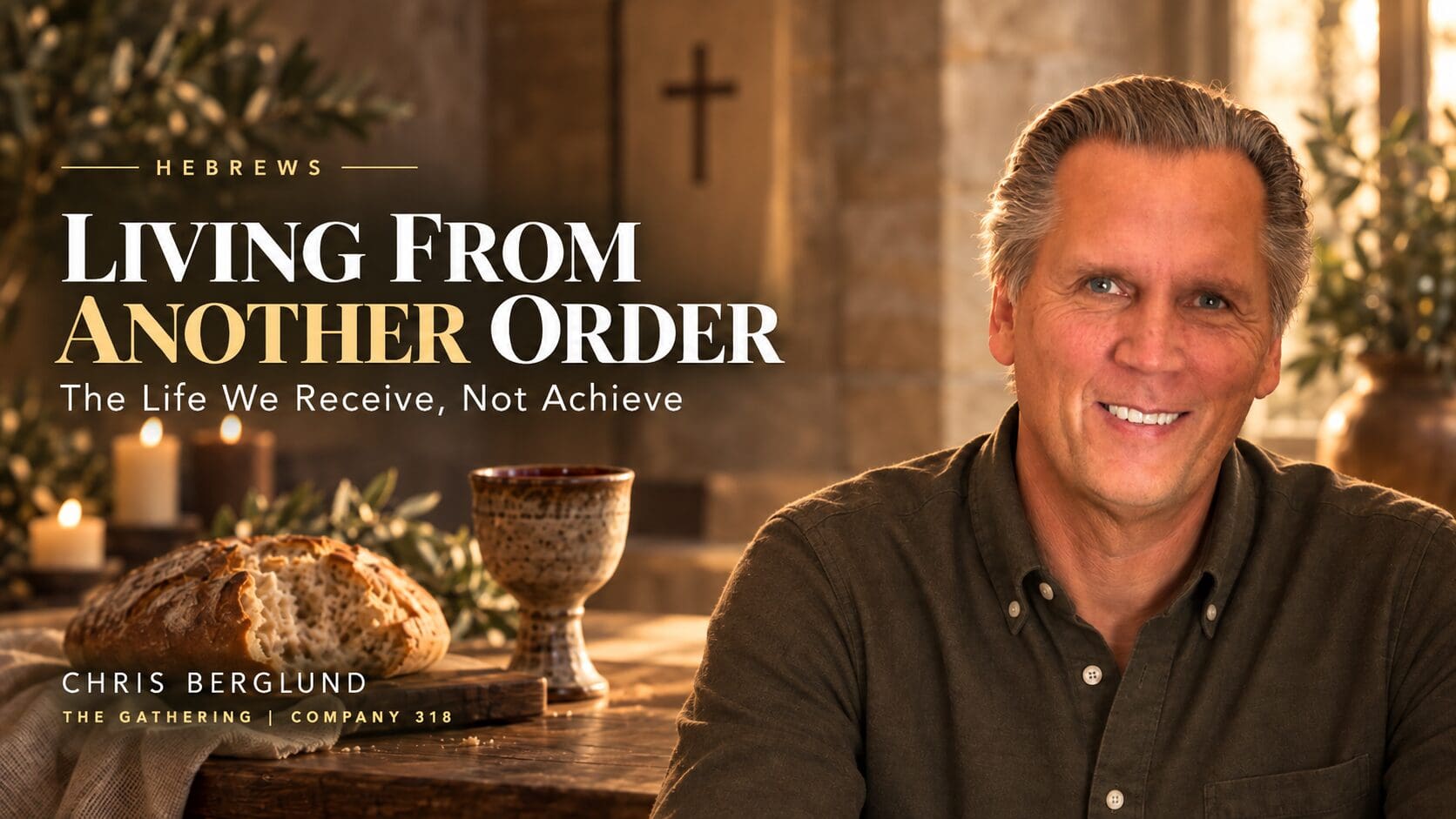
In his message Living From Another Order | The Life We Receive, Not Achieve, Chris Berglund traced the biblical revelation of Jesus as our eternal Priest-King according to the order of Melchizedek and showed why this matters far beyond a theological discussion about an unusual figure in Genesis.
The order of Melchizedek ultimately reveals something about Jesus—and therefore something about the life we have received in Him.
Watch or rewatch the full message here.
What Is the Order of Melchizedek?
Melchizedek first appears briefly in Genesis 14 when Abraham returns from battle. He is introduced as both king and priest, and he meets Abraham with bread and wine.
His appearance is brief, but Scripture does not leave him behind.
Psalm 110 speaks prophetically of a coming Priest who would remain forever “according to the order of Melchizedek.” The book of Hebrews then takes that language and applies it directly to Jesus.
Hebrews 7 describes Christ as a Priest who has become such, not according to the requirement of physical descent, but “by the power of an indestructible life.”
That phrase is essential.
The Levitical priesthood depended upon genealogy. A priest qualified because he belonged to a particular family line. His ministry was also temporary because every priest eventually died and another had to take his place.
Jesus belongs to another order entirely. His priesthood is not sustained by genealogy, ritual, or human performance. It is sustained by His own endless, resurrected life.
The point of Melchizedek, then, is not merely to solve the mystery of who this ancient priest-king may have been. Melchizedek becomes a frame through which Scripture helps us behold Christ.
And once we see Christ, the question becomes much more personal: What does it mean for us to be found in Him?
The Gospel Is Larger Than Forgiveness
Forgiveness is glorious. The blood of Jesus has dealt decisively with sin, and nothing should ever diminish the wonder of that truth.
But forgiveness was never the end of the Father’s purpose.
Before sin ever entered the human story, there was already a purpose in the heart of God.
Ephesians 1 tells us that we were chosen in Christ before the foundation of the world and predestined for adoption. Hebrews 2 speaks of God bringing many sons to glory. In John 17, Jesus prays that those who belong to Him would participate in the communion He shares with the Father.
Taken together, these passages reveal something breathtaking. The Father’s eternal purpose has always centered upon His Son.
He desired a people who would share the life of the Son, live in communion with Him, and make that life visible in the world.
The Gospel is therefore much larger than the announcement that our sins can be forgiven so that we can go somewhere better when we die. Through Christ, we are brought into His life.
We are united with Him in His death and resurrection. We receive the Spirit. We are brought into sonship. We participate in the life of the Son and become a people through whom His character can be expressed on the earth.
This is the difference between merely receiving benefits from Jesus and actually participating in the life of Jesus.
From Religious Performance to Indestructible Life
This is why the order of Melchizedek matters so much.
Hebrews is describing more than a change in religious administration. It announces a change of priesthood and, with it, an entirely new basis from which life with God is lived.
The old priesthood could point toward perfection, but it could not produce it. Sacrifices had to be repeated. Priests came and went. The entire system testified that something greater was still coming.
Then Christ came.
His sacrifice does not need repeating. His priesthood does not expire. His life cannot be destroyed. He lives forever.
And the extraordinary announcement of the Gospel is that believers have been joined to Him.
We have not simply been given a new set of religious instructions and told to perform them more successfully than everyone before us.
We have received a Life.
Hebrews Gives Us the Order. Romans Shows Us How to Live in It.
One of the most important connections Chris made in this message was between Hebrews and Romans.
Hebrews gives us the theological architecture of the Melchizedek priesthood. Romans 5–8 shows us what it means to live from that reality.
Romans tells us that Christ did not simply die for us as an external transaction. We were joined to Him in His death and resurrection.
Romans 6 says that we were baptized into His death and raised with Him so that we might walk in newness of life. Romans 8 moves even further, describing life in the Spirit, freedom from condemnation, adoption, sonship, and the Spirit of Christ dwelling within us.
This is where Christian formation changes.
If we do not understand union with Christ, we will almost inevitably turn the Christian life back into another version of the old order. We will try to prove ourselves. We will attempt to become spiritual enough. We will try to produce holiness through effort. We will measure ourselves against other believers.
We may use New Testament language while quietly living from an Old Testament assumption: If I perform correctly, perhaps I can become acceptable.
Romans overturns that entire architecture.
The Christian life begins with what God has accomplished in Christ. We died with Him. We were raised with Him. His Spirit dwells within us. We belong to another. We have received another Life.
The Life We Receive, Not Achieve
This does not mean obedience disappears. It means obedience finally finds its proper source.
Grace is not permission to become passive. Grace is the empowering presence of Christ Himself.
There is labor in the Christian life. There is obedience. There are choices, disciplines, acts of love, sacrifice, service, forgiveness, prayer, and faithfulness.
But the direction has changed.
We are not working toward union with Christ. We are learning to live from union with Christ.
We are not obeying so that we can become sons and daughters. We obey because in Christ we have been brought into sonship.
We are not producing spiritual fruit to prove that we possess His life. Fruit emerges because we are abiding in the Vine.
This is why Jesus continually brings us back to abiding: “Abide in me, and I in you.”
The branch does not strain to manufacture the life of the vine. It receives that life and bears the fruit produced by that communion.
The Christian life works the same way.
Our calling is not to imitate Jesus from a distance while relying upon our own resources. We have been invited to participate in His life.
A Royal Priesthood in Christ
Peter calls the people of God “a royal priesthood.”
Those two words belong together: royal priesthood. King and priest.
The pattern seen in Melchizedek reaches its fulfillment in Jesus, the true Priest-King. And because our identity is found in Christ, His life begins to define ours.
Priesthood speaks of communion with God. Kingship speaks of stewardship and the expression of His authority. Neither begins with self-importance. Both flow from union.
We minister because we are first receiving. We carry His presence because we live in His presence. We exercise authority only as participants in the authority of Christ.
The order matters.
Communion comes before expression. Receiving precedes giving. Being precedes doing. The indicative comes before the imperative.
The Veil Is Torn. Access Is Open.
The old system continually communicated distance.
Only certain priests could enter certain places. The high priest entered the Holy of Holies under carefully prescribed conditions.
But in Christ, the veil has been torn.
Hebrews invites believers to draw near with confidence.
Why? Not because we finally perfected our spiritual performance, but because our High Priest has finished His work.
Our confidence is not confidence in ourselves. It is confidence in Him.
We come boldly because Jesus has opened the way.
This changes prayer. It changes worship. It changes spiritual formation. It changes how we understand holiness. It even changes how we respond when we fail.
We are no longer trying to climb our way back into a place from which we have been expelled. We return again to Christ, to grace, to communion, to the finished work, and to the Life that remains our only true source.
Living From Another Order
This is the invitation: to stop treating Christianity as an attempt to reproduce the life of Jesus through human effort.
We can stop building our spiritual lives around proving, achieving, comparing, and performing and instead behold the One whose priesthood is established according to the power of an indestructible life.
And then we discover that this One has joined us to Himself.
The life we were unable to manufacture has been given. The holiness we could never produce has a Source. The love we struggle to sustain has a Source. The fruit of the Spirit has a Source. Our transformation has a Source.
Christ Himself is our life.
The Gospel does not merely give us something new to believe. It places us in Someone from whom we can finally live.
Perhaps this is one of the great recoveries needed in the Church today: The Christian life is not primarily a life we achieve for God. It is the life of Christ we receive, abide in, and allow to become visible through us.
Watch the Full Message
Living From Another Order | The Life We Receive, Not Achieve | Chris Berglund
Watch or rewatch the full message on YouTube.
Continue Exploring
The Gathering is a local church and teaching community in Colorado Springs learning together to live from the life of Christ. Visit The Gathering.
Explore more messages on union with Christ, the finished work of Jesus, covenant, the order of Melchizedek, and the formation of a people in Christ on our Teaching page.
Company 318 is our wider teaching and formation community with Leah Ramirez and Chris Berglund. Learn more about Company 318 or join Company 318 on Substack.
For those who want to go deeper into Romans 5–8, union with Christ, Apostolic Architecture, and Jesus as our eternal Priest-King according to the order of Melchizedek, explore Behold School.
If you are in Colorado Springs, we would love to have you gather with us. We meet Sundays at 10:00 a.m. at 720 Elkton Dr., Colorado Springs, CO 80907. Plan your visit.
You can also watch The Gathering and Company 318 on YouTube and follow The Gathering on Facebook.
Your generosity helps The Gathering, Company 318, and Behold School continue forming people in the Gospel and making biblical teaching available locally and beyond. Partner with us here.
Living From Another Order
Leave a Reply Cancel reply

THE GATHERING
A local church and teaching community in Colorado Springs.
Sundays at 10:00 a.m.
720 Elkton Dr.
Colorado Springs, CO 80907
EXPLORE
LIFE TOGETHER
WIDER COMMUNITY
SUPPORT & CONTACT
About The Gathering
Leah Ramirez
Chris Berglund
Teaching
Reflections / Blog
Devotionals
Small Groups
Beholding and Prayer
The Grove
Planted Youth
Company 318
Behold School
Latest Teaching
YouTube
Facebook
Give
Contact Us
info@the-gathering.us
407-340-0204
@ 2026 The Gathering
What We Believe
Waic Up Call - Y.A.
The Vine - Kids