
September 7, 2026
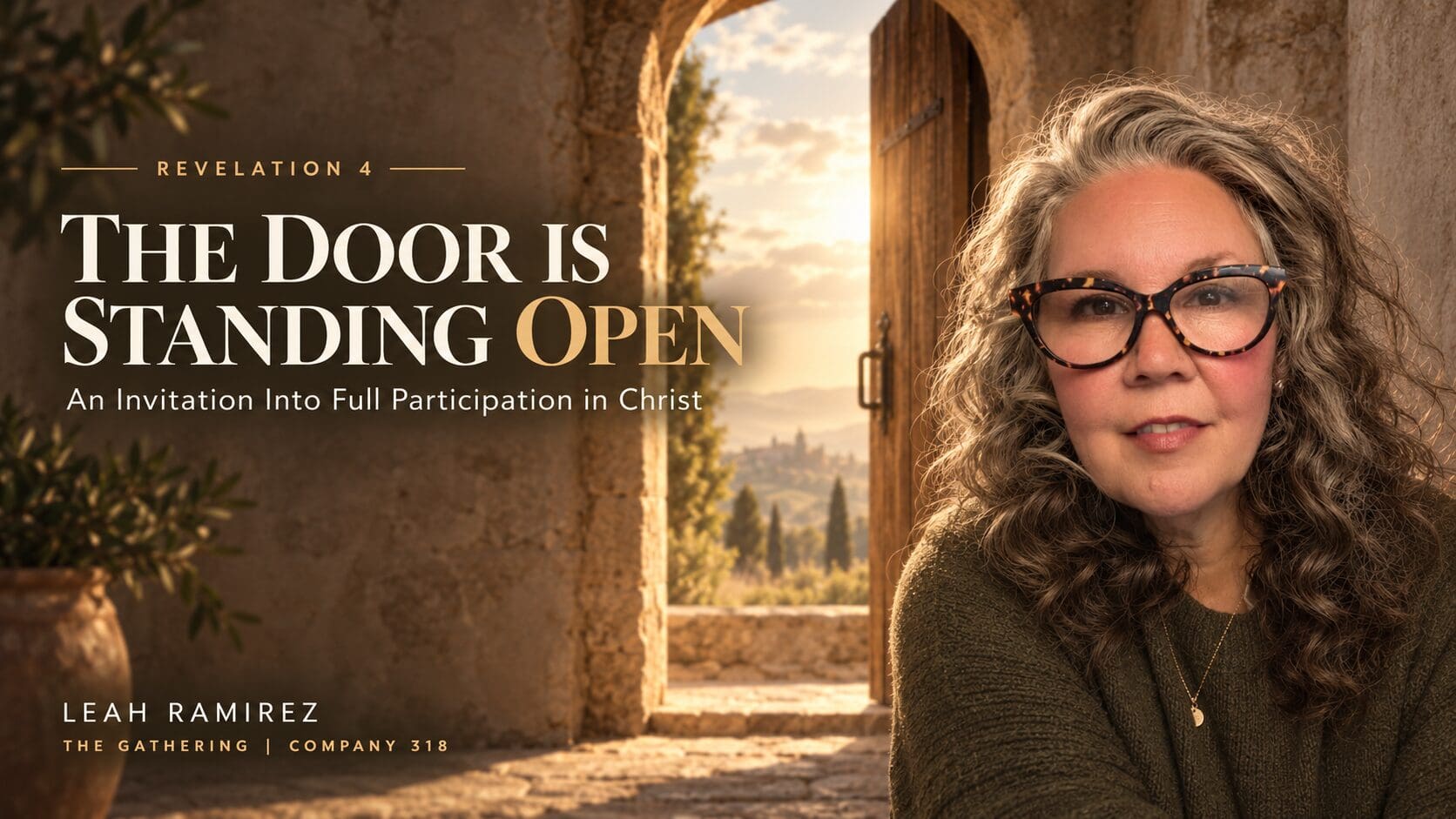
All week long, I kept hearing one phrase: “Behold, a door standing open in heaven.”
It comes from Revelation 4, when John looks and sees an open door and hears the invitation, “Come up here.” I couldn’t get away from those words, because they seemed to speak so directly to what the Lord has been teaching us together at The Gathering.
There is a door standing open. Not a door we are trying to pry open through enough prayer, enough fasting, enough worship, or enough spiritual effort. In Christ, the way has already been opened. The table has been set. We have been invited into communion with God, and the deeper question is whether we are beginning to believe where He says we are.
Over the last several weeks at The Gathering in Colorado Springs, we have kept returning to one question: Have you concluded where you are located?
That may sound like a strange question at first, but I think it gets to the heart of so much of the Christian life. It is possible to know the Gospel, love Jesus, attend church, pray, worship, and still spend much of our lives thinking as though God is somewhere over there and we are somewhere over here trying to get to Him. We can believe in reconciliation while still living with a deeply ingrained sense of separation.
But the Gospel tells a very different story.
Why We Gather
Before talking about where we are located, I think it is worth asking why we gather at all. Why do we come together as the ecclesia on Sundays, around tables, in homes, in prayer meetings, and in worship?
I believe one of the primary reasons we gather is to remind one another of what is true. We do not gather because Christ has been absent from our lives all week and we need to somehow bring Him near again. We do not gather because we have fallen out of union and need to worship our way back in. We gather because we belong to one another in Christ, and because we need one another to keep calling us back to what is already true.
Sometimes I need you to look me in the eyes and remind me of who God is when circumstances have distorted my vision. Sometimes you need me to remind you what Christ has accomplished when fear, disappointment, or pain has made another story feel more believable. Together we remind one another who He is, who we are because of Him, and where we actually live.
There is something deeply communal about remembering the Gospel.
Where Are You Located?
When we actually begin looking at the language of the New Testament, Paul’s answer to this question is remarkably consistent: we are in Christ.
Ephesians 2 says that God made us alive together with Christ, raised us up with Him, and seated us with Him in the heavenly places in Christ Jesus. Colossians 3 says that we have been raised with Christ and that our lives are hidden with Christ in God. First Corinthians 1:30 says something I especially love: “By His doing you are in Christ Jesus.”
That phrase matters. By His doing.
Our life in Christ did not begin with our ability to climb high enough, pray hard enough, or become spiritual enough. God is the initiator. He is the One who has acted in Christ, and our security rests in His action rather than ours.
Then Jesus takes the language even further in John 14:20: “In that day you will know that I am in My Father, and you in Me, and I in you.”
That is not simply a theological idea to agree with. Jesus is describing mutual indwelling. We are in Him, and He is in us. John 15 carries the same reality when Jesus says, “Abide in Me, and I in you.”
The Christian life, then, is not merely a life lived toward Christ. It is a life lived from within Christ.
This has become one of the most transforming truths of my own life. The Gospel is not an invitation to spend the rest of our lives trying to reach a place God says He has already given us in His Son. Paul tells us that we died with Christ, were buried with Christ, were raised with Christ, are seated with Christ, and now have our lives hidden with Christ in God. Christ lives in us, and we have become one spirit with Him.
Our belonging is there, and from that place our assignment is here. We are citizens of heaven who have been sent into this world as ambassadors of Christ.
That changes the way we understand spiritual formation. Transformation is no longer me standing outside the life of Jesus and trying desperately to imitate Him. It becomes participation in the life He is sharing with me.
The Cloth in the Dye
As I was praying about this message, I found myself remembering an illustration Reinhard Bonnke used for baptism in the Holy Spirit. He would talk about the ancient practice of dyeing cloth. The cloth was immersed into the dye until eventually the cloth was in the dye and the dye was in the cloth.
I love that picture because it gives us language for something much deeper than occasionally receiving something from the Holy Spirit when we need help. The cloth does not stand beside the dye and work harder to imitate its color. It is immersed, and because it is immersed, what surrounds it begins to permeate it.
That is such a beautiful picture of life in the Spirit.
Bonnke would also sometimes describe the Holy Spirit as “liquid fire,” and that adds another dimension to the image. Water speaks of immersion, dye speaks of permeation, and fire speaks of transformation. God is not inviting us to stand at the edge of His life and occasionally reach in for what we need. He is inviting us into participation, into a life where we are surrounded by Him, filled with Him, and increasingly transformed by the One in whom we live.
Maybe this is where our conversation about being Spirit-filled needs to begin. Not first with, “What can I get from the Holy Spirit?” and not even first with, “What can the Holy Spirit do through me?” Perhaps the better question is, What would it mean to live fully immersed in Him?
What Does Life in the Spirit Actually Look Like?
Depending on the church tradition we come from, we may answer that question very differently. Some of us hear “Spirit-filled” and immediately think about tongues, prophecy, healing, miracles, and the gifts of the Spirit. Others hear that language and think of love, joy, peace, patience, kindness, goodness, faithfulness, gentleness, and self-control.
Without realizing it, we can begin measuring one another according to whichever expression our own tradition has emphasized. The charismatic can look at someone who does not speak in tongues and wonder whether something is missing. The evangelical can look at charismatic expressions of power and wonder whether there is enough character to go with them.
But what if both conversations are beginning too far downstream?
What if the deepest question is not first, “Which gifts do you have?” and not even first, “How much fruit are you displaying?” What if the deeper question is whether we are learning to participate in the life of Christ through the Spirit?
The fruit and the gifts are not competing definitions of spirituality. They are expressions of the same indwelling Spirit. The fruit reveals His character, and the gifts reveal His activity, but both flow from something deeper: participation in His life.
We Are Not the Source
Galatians 5 gives us the fruit of the Spirit: love, joy, peace, patience, kindness, goodness, faithfulness, gentleness, and self-control. But I think we need to put that passage right beside John 15, where Jesus says, “Abide in Me, and I in you,” and then makes the startling statement, “Apart from Me you can do nothing.”
Most charismatic Christians understand this fairly easily when we talk about supernatural gifts. None of us thinks we can heal the sick on our own, manufacture a prophetic word, or create a miracle. We understand that we are dependent upon the Spirit.
But I wonder whether we believe that just as deeply about love.
We may be much more tempted to think that if we simply try harder, we can make ourselves more patient, more kind, or more self-controlled. But Jesus gives us the picture of a branch connected to a vine. The branch does not manufacture fruit. It bears fruit because it is participating in the life of the vine.
Christ is the Source.
The Holy Spirit is not helping an independent version of me become a nicer person. He is expressing the life and character of Christ through a people who are abiding in Him. And the same is true of the gifts.
In 1 Corinthians 12, Paul calls the gifts “manifestations of the Spirit.” I think that word matters. The gifts are not primarily evidence of how gifted we are; they are manifestations of Him. Wisdom, knowledge, faith, healing, miracles, prophecy, discernment, tongues, and interpretation are the activity of the Spirit becoming visible through His people.
In the same way, the fruit is His character becoming visible through His people.
Neither comes from us as the source. We cannot manufacture healing apart from Him, but neither can we manufacture the love of Christ apart from Him. We cannot manufacture prophecy apart from Him, but neither can we manufacture His patience, kindness, joy, or peace.
The branch participates in the Source. Perhaps this is what full participation in the life of the Spirit begins to look like: His character becoming visible through us, His power becoming visible through us, and ultimately His life becoming visible through us.
Faith Is Agreement, Not Spiritual Striving
This also changes the way we think about faith.
Faith is not me trying to generate enough spiritual force to make something happen. Christian declarations are not incantations where the right combination of words finally unlocks heaven. The power is not in finding a magical arrangement of words. Our confidence is in the One who has spoken.
Faith responds to revelation. God reveals what is true, and we give ourselves to agreeing with Him.
This is part of what Paul is doing in Romans 6 when he tells believers to “consider yourselves to be dead to sin, but alive to God in Christ Jesus.” He is teaching us to reckon our lives from our new location. Believe what God says is true, and learn to live from there.
That does not mean denying difficult circumstances. It means circumstances no longer get to make the final decision about who we are or where we are located.
I was confronted with that very personally this week. Something old got touched in me, and suddenly a wound I thought I had dealt with years ago was right there again. I found myself realizing how committed God is to healing the lenses through which we see Him and through which we interpret our own lives.
Jesus did not live one day convinced of His relationship with the Father and spend the next wondering whether He had somehow fallen out of it. He could be in the middle of a storm and remain in communion with His Father. He could stand before thousands of people and remain rooted in that same communion. He could experience betrayal and still know exactly who He was and whose He was.
God is forming that kind of life in us, something rooted deeply enough in Christ that it cannot be shaken by every changing circumstance.
A Door Standing Open
This is why I keep coming back to Revelation 4. John says, “After this I looked, and behold, a door standing open in heaven,” and then hears the Lord say, “Come up here.”
I have been hearing those words as an invitation to see what is already true in Christ. The door of participation stands open. In fact, in Christ we have already been received. We do not have to relate to God as though He is perpetually distant and must somehow be persuaded to come near.
The invitation is to see ourselves where He says we are, to believe that we are in Christ and Christ is in us, and then to begin living from that reality.
But I also do not think this invitation is only about “me and Jesus.” I believe it is about us with Him.
The Lord is forming mature sons and daughters in the Son, and that happens in family, in community, in the ecclesia. I will not mature without you, and you will not mature without me. Somehow, in Christ, we belong to one another.
That is part of what I believe God is inviting us into at The Gathering here in Colorado Springs. We want to become a people increasingly convinced of our life in Christ, immersed in the Holy Spirit, and willing to participate together in everything He wants to reveal through His church.
The picture of the cloth and the dye still says it beautifully. We are in the Spirit, and the Spirit is in us. We are learning to live from a union we did not create, receiving His character and His activity as the life of Christ becomes visible through His people.
There really is a door standing open, and I believe the invitation of Jesus is still, “Come up here.”
Watch the Full Message
The Door Is Standing Open | Full Participation in Christ | Leah Ramirez
Watch the full message on YouTube
If you live in the Colorado Springs area and are looking for a local church where we are learning together about union with Christ, life in the Spirit, prayer, worship, Scripture, and authentic Christian community, we would love to have you join us at The Gathering.
The Gathering: the-gathering.us
Behold School: Behold School is our online school for those who want to go deeper in the Gospel, union with Christ, spiritual formation, Scripture, and learning to live from our true location in Him. beholdschool.com
Company 318 on Substack: Read more from Leah Ramirez and Chris Berglund as we continue writing and teaching about union, communion, the Gospel, and the life of Christ. company318.substack.com
Partner With The Gathering: If you would like to support what God is building through The Gathering, you can give at the-gathering.us/partner.
The Door Is Standing Open | Full Participation in Christ
Leave a Reply Cancel reply

THE GATHERING
A local church and teaching community in Colorado Springs.
Sundays at 10:00 a.m.
720 Elkton Dr.
Colorado Springs, CO 80907
EXPLORE
LIFE TOGETHER
WIDER COMMUNITY
SUPPORT & CONTACT
About The Gathering
Leah Ramirez
Chris Berglund
Teaching
Reflections / Blog
Devotionals
Small Groups
Beholding and Prayer
The Grove
Planted Youth
Company 318
Behold School
Latest Teaching
YouTube
Facebook
Give
Contact Us
info@the-gathering.us
407-340-0204
@ 2026 The Gathering
What We Believe
Waic Up Call - Y.A.
The Vine - Kids