
September 21, 2026
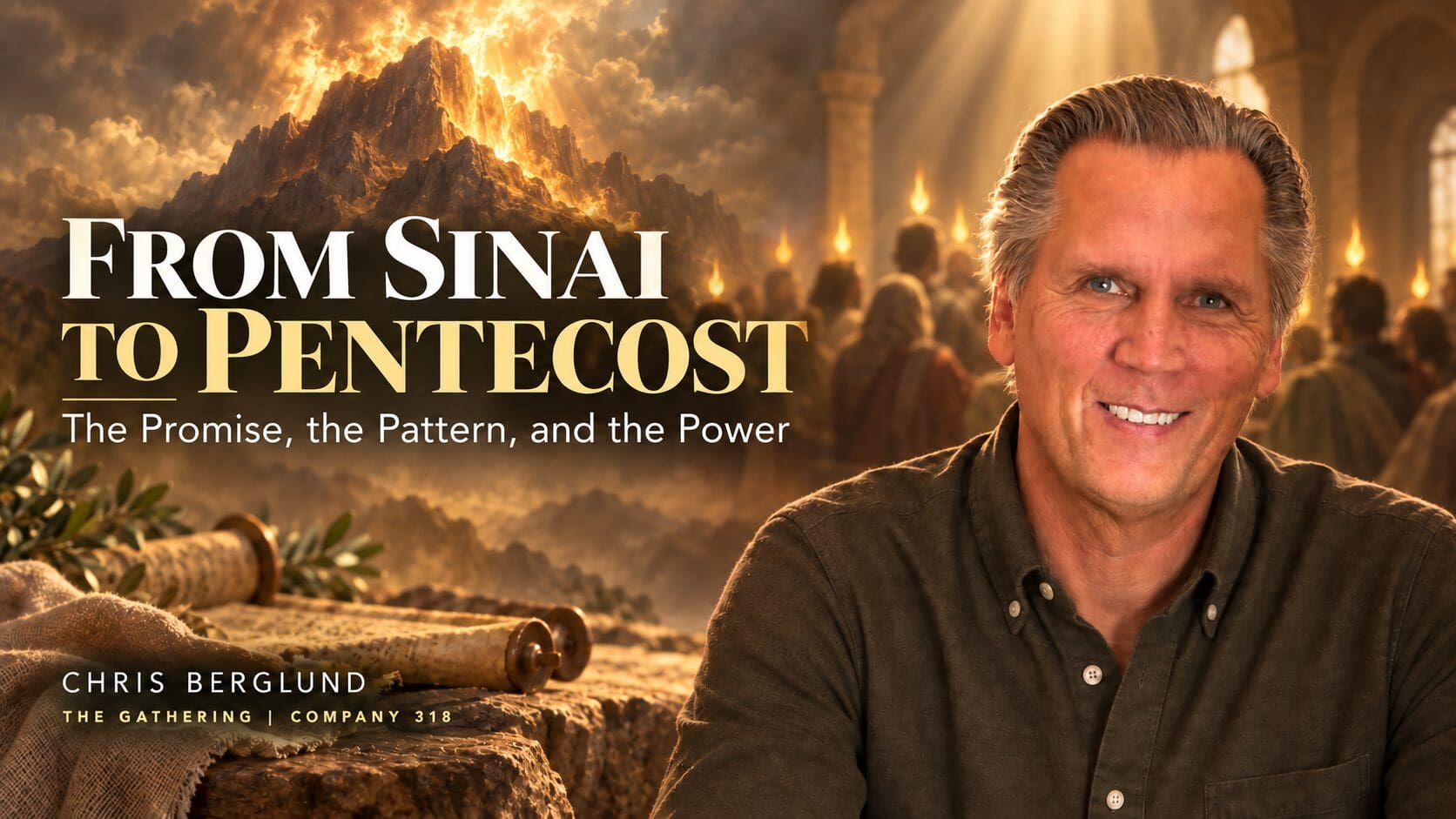
The Promise, the Pattern, and the Power
Chris Berglund | The Gathering
What if the Ten Commandments were never meant to be read merely as a list of religious rules? What if, before they were ever carved onto stone, they were revealing something about the life God desired to share with His people? And what if Pentecost was not God abandoning what He revealed at Sinai, but finally supplying the power for that life to become an inward reality?
That is the thread running from Sinai to Pentecost. At Sinai we see the promise. In the Ten Words we see the pattern. At Pentecost we see the power. And all three ultimately find their fulfillment in Christ.
The story does not begin in Exodus 20 with, “You shall.” It begins in Exodus 19 with what God has already done: “You yourselves have seen what I did to the Egyptians, and how I bore you on eagles’ wings and brought you to myself.” Before God ever gave Israel a command, He rescued them, carried them and brought them to Himself.
That order matters. The indicative came before the imperative. Grace preceded instruction. Relationship preceded requirement.
Then God told Israel what He desired for them: “You shall be my treasured possession among all peoples… and you shall be to me a kingdom of priests and a holy nation.” This is bigger than a nation receiving a moral code. God was revealing His desire for a people who would live near Him, carry His presence and reveal His nature in the earth.
A kingdom of priests.
Viewed through the revelation of Hebrews, that desire ultimately takes us beyond the temporary Levitical priesthood to Jesus Himself, the eternal Priest-King after the order of Melchizedek. We are brought into Christ, and therefore brought into His life and His order. The kingdom of priests God desired from the beginning comes to its fullness in the Son.
That context changes the way we hear the Ten Commandments. Exodus 19 through 24 carries the language and movement of covenant. God brings His people to Himself. He declares His desire for them. The people respond. Covenant words are spoken. Blood is sprinkled. A covenant meal is shared in the presence of God.
Seen in that setting, the Ten Words begin to look less like an arbitrary list of restrictions and more like a description of the kind of life that belongs inside communion with God.
Have no other gods. Do not make an idol. Do not take the name of the Lord in vain. Remember the Sabbath. Honor your father and mother. Do not murder. Do not commit adultery. Do not steal. Do not bear false witness. Do not covet.
These words reveal a life sourced entirely in God—a life of undivided communion, true representation, rest, honor, love, faithfulness, generosity, truth and contentment.
The problem was never that these things were bad. The problem was that stone could describe the life, but stone could not produce it.
Paul says in Romans 8 that what the law could not do, weakened as it was through the flesh, God did by sending His own Son, so that the righteous requirement of the law might be fulfilled in us who walk according to the Spirit. The pattern was glorious. Humanity needed the power to live it.
That becomes especially important when we begin to hear the commandments through the life of Christ rather than simply as external rules.
“You shall have no other gods before Me” is not merely an instruction to remove obviously pagan idols. It is an invitation to live from one Source. Christ is not meant to occupy the top position in a hierarchy where God is first, family is second, work is third and everything else falls somewhere beneath them. He becomes the Source of all of it.
We love our families from Him. We work from Him. We serve from Him. We pray from Him. We give from Him. We live from Him. The opposite of idolatry is not simply removing idols. It is single-hearted communion.
The command not to make a carved image also reaches much deeper when we consider the false images of God we are capable of constructing. A distant God. An angry God who must be persuaded to love. A reluctant God. A God separated from His people.
Jesus is the true image of the invisible God. We do not define God by fear, religious history or wounded imagination. We look at Jesus.
And once we behold Him rightly, we are called to bear His name rightly. Taking the Lord’s name is more than speaking a name with our mouths. His people carry His reputation into the world. His mercy becomes visible through our mercy. His patience through our patience. His forgiveness through our forgiveness. His generosity through our generosity.
We do not merely announce that God is loving. His love takes flesh in a people who have received His life.
The Sabbath takes on the same depth. “Remember the Sabbath day, to keep it holy” is about far more than stopping activity for one day. The deepest reality of Sabbath is rest, and biblical rest is not inactivity or passivity. It is dependence.
It is ceasing from self-powered striving and discovering Christ as our Source.
Someone could stop working outwardly while remaining inwardly consumed with anxiety, performance and control. Someone else could be actively serving, building, creating, praying or loving while living deeply from the rest of Christ.
Hebrews tells us that a Sabbath rest remains for the people of God. The New Covenant does not simply give us a better Sabbath schedule. It gives us Christ. He becomes our rest.
Jesus does something similar when He takes commandments like “You shall not murder” beneath external behavior and into the human heart. Murder does not begin when a hand takes a life. It begins in contempt, hatred, bitterness, humiliation, slander and the desire to see another person diminished.
So the New Covenant expression of “Do not murder” cannot simply be, “I have never physically killed anyone.” The life of Christ goes much further. Christ within us releases forgiveness instead of revenge, blessing instead of cursing, mercy instead of contempt, encouragement instead of humiliation and restoration instead of destruction.
The question is no longer simply, “Did I break the rule?” The deeper question becomes, “What kind of life is flowing from me?”
The same is true of adultery. The opposite of adultery is not merely avoiding an affair. It is faithfulness. It is becoming the kind of person whose word can be trusted, whose love remains steady and whose life reflects the faithfulness of Christ.
The opposite of stealing is not simply refusing to take another person’s possessions. It is generosity. A heart that knows it has received freely from Christ no longer has to grasp at another person’s calling, provision, position or life.
Bearing false witness also becomes much more than simply refusing to tell a lie. It means refusing to define people by their failures. Instead of gossip, we defend. Instead of exposing for the sake of humiliation, we cover in love. Instead of fastening someone permanently to the worst thing they have ever done, we learn to see according to the redemptive purpose of God.
Then comes the final commandment: “You shall not covet.”
This one is striking because it reaches directly into the heart. Paul himself says in Romans 7:7, “I would not have known what it is to covet if the law had not said, ‘You shall not covet.’” The command exposes desire itself.
And perhaps that reveals what all the commandments were pointing toward. God was never merely after outward compliance. He desired a heart so satisfied in Him that it no longer needed to kill, grasp, steal, distort, compete or covet.
This is where Pentecost becomes so beautiful.
At Sinai, the people heard the words of covenant, but they did not yet possess the indwelling life necessary to become what those words described. The commandments could reveal righteousness. They could expose the heart. They could bear witness to the life God desired. But they could not place that life inside humanity.
Then came Christ.
And then came Pentecost.
The Spirit was poured out. The life that had been revealed externally was now coming to dwell internally.
Paul describes this contrast in 2 Corinthians 3 as the difference between what was written on tablets of stone and what the Spirit writes upon human hearts. This is not God lowering His standard. It is God supplying His own life.
Christianity is not humanity attempting to imitate Jesus with enough determination. It is Christ living His life in and through a people who have become His dwelling place.
“I have been crucified with Christ. It is no longer I who live, but Christ who lives in me.”
The Gospel does not merely forgive the person who could not keep the pattern. The Gospel gives us the Person the pattern was describing.
There is even a striking contrast between Sinai and Pentecost. At the golden calf, approximately three thousand people died. At Pentecost, approximately three thousand received the word and were added to the church. Paul says that “the letter kills, but the Spirit gives life.”
At Pentecost, people from the nations heard the disciples declaring the mighty works of God in their own languages. And what mighty work dominates Peter’s sermon immediately afterward? Jesus. His crucifixion. His resurrection. His exaltation.
The Spirit had come to magnify the Son.
The answer to Sinai was never greater human determination. The answer was always Christ.
Near the end of Sunday’s gathering we reflected on another beautiful picture. The tablets of covenant were placed inside the Ark of the Covenant, in the place associated with the presence of God. Under the New Covenant, God has not simply handed us another set of instructions and asked us to carry them better. He has made us His dwelling place.
The mystery hidden for generations has now been revealed: “Christ in you, the hope of glory.”
His intention is not to occupy one religious compartment of our lives while we manage everything else. He desires to permeate the whole. No compartments. No closets withheld from Him.
Christ becomes the life within the whole of our lives.
And perhaps this is where the invitation becomes most personal.
It is possible to become so occupied with changing the world, reaching people, praying for revival, building ministries and meeting needs that we forget the One from whom all true ministry flows. God absolutely longs to be known. He longs for our families, our cities, our neighbors and the nations.
But we cannot get ahead of participation.
Before we carry the bread, we eat.
Before we offer the wine, we drink.
Before we announce communion, we receive it.
Jesus sets Himself before us as the feast—His love, His mercy, His faithfulness, His righteousness, His rest, His intercession, His longing, His life.
This is the movement from Sinai to Pentecost. The promise was always a people who belonged to God. The pattern revealed what His life looked like. And the power is the Holy Spirit making Christ Himself alive within us.
The invitation is no longer simply, “Try harder to obey.”
Come to the table. Receive His life. Abide in the Source. And let the life of Jesus become visible in you.
Watch the full message:
From Sinai to Pentecost | The Promise, the Pattern, and the Power | Chris Berglund
Stay Connected
The Gathering
https://the-gathering.us/
Teaching
https://the-gathering.us/teachings
Company 318
https://the-gathering.us/company-318
Company 318 on Substack
https://company318.substack.com/
Behold School
https://the-gathering.us/behold-school
Plan Your Visit
https://the-gathering.us/plan-your-visit
YouTube
https://www.youtube.com/@Company-318/streams
Partner With / Give to The Gathering
https://the-gathering.us/partner
The Gathering | Colorado Springs, Colorado
Rooted in the Gospel. Gathered in Prayer. Growing in the Word.
From Sinai to Pentecost
Leave a Reply Cancel reply

THE GATHERING
A local church and teaching community in Colorado Springs.
Sundays at 10:00 a.m.
720 Elkton Dr.
Colorado Springs, CO 80907
EXPLORE
LIFE TOGETHER
WIDER COMMUNITY
SUPPORT & CONTACT
About The Gathering
Leah Ramirez
Chris Berglund
Teaching
Reflections / Blog
Devotionals
Small Groups
Beholding and Prayer
The Grove
Planted Youth
Company 318
Behold School
Latest Teaching
YouTube
Facebook
Give
Contact Us
info@the-gathering.us
407-340-0204
@ 2026 The Gathering
What We Believe
Waic Up Call - Y.A.
The Vine - Kids