
July 20, 2026
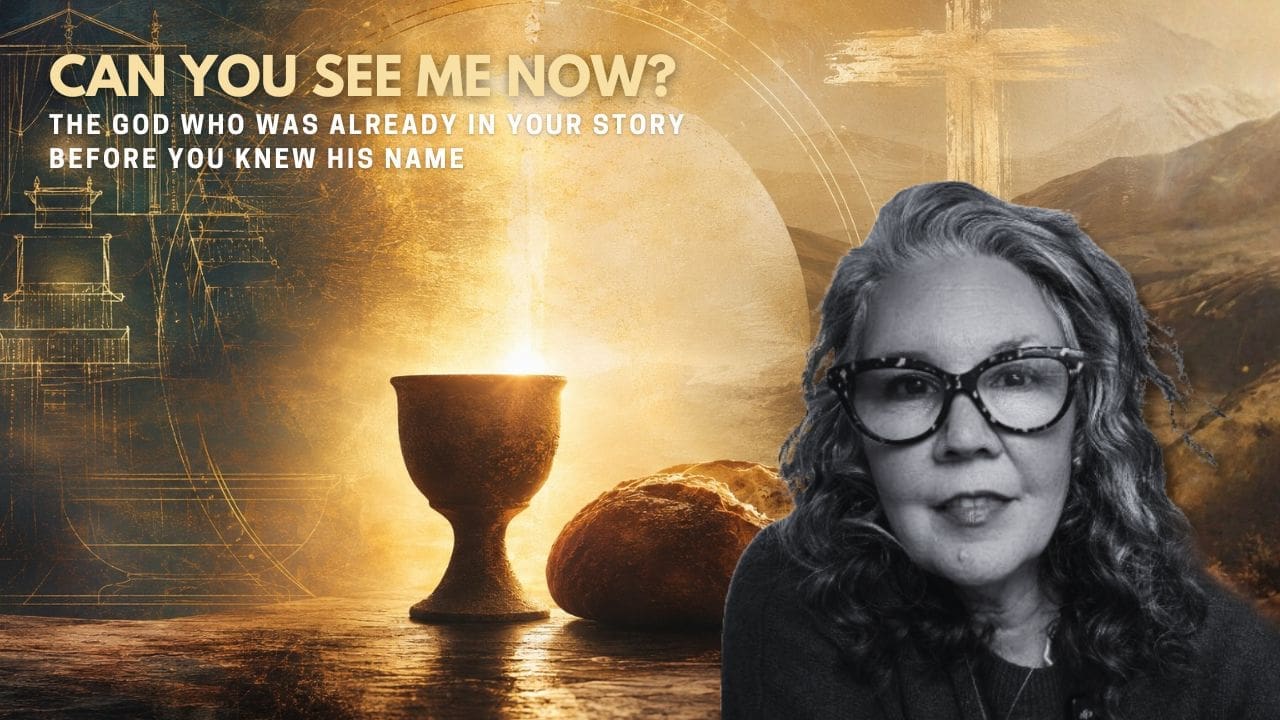
The God Who Was Already in Your Story Before You Knew His Name
Sometimes it feels as though God is adjusting the lens through which we see everything.
Is this clearer?
What about this?
And we find ourselves saying, I don’t know anymore.
What is the true lens of the gospel? How do we behold Jesus as the Light without being blinded by religious assumptions, distorted theology, or ideas about God that were handed to us before we ever learned to recognize His face?
Jesus is the message. He is the center of the gospel. He is the substance.
And yet, throughout Scripture, God gives us shadows through which we can discern Him.
John did not simply announce, “Behold Jesus.”
He declared:
“Behold, the Lamb of God, who takes away the sin of the world!”
—John 1:29
John could stand directly in front of the fulfillment and recognize Him because he understood what Jesus was fulfilling.
The lamb was not God’s first idea.
Jesus is the Lamb slain from before the foundation of the world. God formed the nature of the lamb in creation so that, when His Son appeared, humanity would possess language through which to recognize Him.
The shadows were never intended to replace Jesus.
They were given to help us see Him.
The House Was Always a Person
The writer of Hebrews begins by calling us to “consider Jesus,” the Apostle and High Priest of our confession.
Moses was faithful as a servant in God’s house, but Christ is faithful over God’s house as a Son.
And then the writer says something astounding:
“And we are his house.”
—Hebrews 3:6
Religion can become fascinated with the architecture of the tabernacle for the tabernacle’s sake. We study the outer court, the inner court, and the Holy of Holies as though God’s ultimate purpose were a building.
But the tabernacle was always pointing to a person.
You are the temple of His Spirit.
God did not create your nature to resemble the tabernacle. He instructed Moses to build the tabernacle in a way that would reveal something about your nature and His desire to dwell within you.
The pattern was preaching Christ.
The architecture was preaching union.
The house was always meant to become a people filled with His glory.
The Sabbath Was Revealing Your Original Design
Hebrews then begins to speak about rest.
God rested on the seventh day, not because He was exhausted, but because the work was complete. The Sabbath was then given to humanity as a revelation of His nature and ours.
Jesus said:
“The Sabbath was made for man, not man for the Sabbath.”
—Mark 2:27
The command to rest was never merely about religious compliance. God was revealing the life for which humanity had been created.
We were made to live from His finished work.
We were made to participate in His rest.
We were not designed to climb our way toward God through striving, performance, or religious achievement. We were created in His image and invited to live from the abundance of His completed work.
Even the commandment was pointing backward toward original design.
The Battle Before the Encounter
This brings us to Abram and his meeting with Melchizedek in Genesis 14.
Abram had been called by God to leave his father’s house and journey toward a land he had never seen. He did not possess a complete theological system. He simply heard God and moved with what he knew.
When Abram learned that his nephew Lot had been taken captive, something rose within him.
He gathered 318 trained men who had been born in his household and went on a rescue mission. He defeated the kings, recovered Lot, and liberated the women and the people who had been taken.
It was immediately after this battle that Melchizedek appeared.
“And Melchizedek king of Salem brought out bread and wine. He was priest of God Most High.”
—Genesis 14:18
I have often wondered why this meeting happened here.
Why did Abram encounter this mysterious priest-king after the battle?
Perhaps there is something about being provoked for the rescue of a generation that prepares us to recognize the Priest-King.
The encounter with Melchizedek was not disconnected from the liberation of captives.
The battle led Abram to the table.
The Priest-King Reinterprets the Battle
Melchizedek came carrying bread and wine.
He did not meet Abram with another assignment.
He did not tell him to build an altar, perform a ritual, or prove his devotion.
He brought the signs of finished work.
Then he blessed Abram and declared:
“Blessed be God Most High,
who has delivered your enemies into your hand!”
—Genesis 14:20
In one sentence, Melchizedek reinterpreted Abram’s entire battle.
Abram may have believed the rescue began with his own compassion, courage, or determination. But the priest-king revealed that God had been present and active before Abram understood what was happening.
Abram, this rescue was not merely your idea.
I was in the stirring.
I was in the compassion.
I was in the battle.
You are not presenting Me with your victory. I was working within you to accomplish the victory.
Before Abram fully knew God, God was already animating Abram’s life.
Before the formal encounter, there had already been an encounter.
The God Who Was Already There
Jesus does this repeatedly in the Gospels.
Nicodemus came to Jesus under the cover of darkness and said:
“Rabbi, we know that you are a teacher come from God.”
—John 3:2
Nicodemus believed he was bringing Jesus his conclusion.
Jesus responded by pointing to the source of his recognition.
You could not perceive what is from above unless something within you had already been awakened from above.
Nicodemus had come to meet Jesus, but Jesus revealed that God had been drawing him before he ever began the journey.
When Nathanael came to Jesus, Jesus told him:
“Before Philip called you, when you were under the fig tree, I saw you.”
—John 1:48
Again, Jesus pointed to the encounter before the encounter.
Nathanael, I was present before you recognized Me.
This is how Jesus reveals the Father.
God has been present in the story longer than we knew.
Evangelism as Unveiling
This changes the way we understand evangelism.
The harvest is not waiting for us to persuade God to become involved. The Holy Spirit has already been poured out. God has already given His Son. The world has already been reconciled to God through Christ.
Our message is not that people must travel an impossible distance to find a reluctant God.
Our message is:
Can you see Him now?
Can you recognize Him in the longing you have carried?
Can you recognize Him in the mercy that kept you alive?
Can you recognize Him in the questions you could never silence?
Can you recognize Him in the moment you knew there had to be something more?
Can you recognize Him in the love that made you fight for your children?
Can you recognize Him in the hunger that caused you to come looking?
God is not absent from the darkness.
The psalmist declared:
“If I make my bed in Sheol, you are there!”
—Psalm 139:8
There may be darkness. There may be blindness. There may be a veil.
But God has not abandoned His creation.
We do not bring an absent God into someone’s story. We announce the God who is already there and turn on the light.
The gospel possesses its own magnetism because it reveals the truth for which humanity was created.
The Indicative Before the Imperative
The church often begins with the imperative:
Do this.
Stop doing that.
Obey.
Be holy.
Do not sin.
Those commands matter. But the apostles did not begin there.
They began with the indicative—the declaration of what is already true because of Jesus.
You died with Christ.
You were raised with Christ.
You are alive to God.
Christ lives in you.
You are seated with Him.
You are in Him.
Then, because this is true, live from that reality.
Religion reverses the order.
It says, “Stop sinning so that you can prove you have died with Christ.”
The gospel says, “You died with Christ; therefore, do not allow sin to define your life.”
Religion says, “Live correctly so God will receive you.”
The gospel says, “God has received you in His Son; therefore, live as one who belongs to Him.”
The order matters.
The order is the gospel.
Transformation does not produce union. Transformation flows from union.
The Running God
Jesus revealed this same truth in the story commonly called the parable of the prodigal son.
But perhaps it would be more accurate to call it the story of the running God.
The younger son squandered his inheritance in a distant country. Eventually, hungry and humiliated, he began the journey home with a speech prepared.
He would confess his failure.
He would announce his unworthiness.
He would ask to become a servant.
But while he was still far away, his father saw him.
And his father ran.
That was the beginning of the son’s lens shift.
The son believed he was walking the long road back to his father. But the father was already running to close the distance.
Before the son could finish his speech, the father called for the robe, the ring, and the feast.
The ring was not sentimental jewelry. It represented the authority and wealth of the household.
The son had squandered everything, yet the father entrusted him again.
This is how Jesus describes the Father.
Then there was the older son.
He had never left the property, but he was just as unable to see the father clearly. He lived beside abundance while thinking like a slave.
The father went out to him too.
“Son, you are always with me, and all that is mine is yours.”
—Luke 15:31
The younger son believed he had to make his way back.
The older son believed he had to earn what had always been his.
Both sons needed a lens shift.
Both needed to see the father.
He Is in the Fire
We often believe we must escape the difficult parts of our lives before we can behold God.
Once this battle ends, I will see Him.
Once my family is restored, I will rest.
Once my finances improve, I will experience His presence.
Once the ministry becomes easier, I will recognize His goodness.
But the meeting with Melchizedek happens in the aftermath of a real battle.
The bread and wine are offered in the middle of the story.
Jesus is not waiting on the other side of your life.
He is the fourth Man in the fire.
The past is not something you must escape before you can find Him. It is something you can allow the Priest-King to reinterpret.
He was there.
He was working.
He was drawing.
He was sustaining.
He was present in ways you did not yet possess the vision to see.
Can You See Him Now?
Perhaps God is adjusting the lens.
Perhaps He is removing the scaffolding of religion that has obscured His face.
Perhaps He is showing you that the journey was never about climbing toward Him.
Jesus was the ladder.
Jesus was the Lamb.
Jesus was the Sabbath rest.
Jesus was the bread and wine.
Jesus was the Priest-King.
Jesus was the fourth Man in the fire.
Jesus was the Father running toward you while you still believed you were walking the long road home.
The gospel does not begin with your pursuit of God.
It begins with the God who pursued you, inhabited your story, and awakened your heart before you ever knew His name.
Today is the day of salvation.
The invitation is not to persuade God to come near.
The invitation is to awaken to the reality that, in Christ, He already has.
Can you see Him now?
Watch the Full Message
Can You See Me Now? | The God Who Was Already in Your Story Before You Knew His Name | Leah Ramirez
Connect With Us
The Gathering
https://the-gathering.us
Give to The Gathering
https://the-gathering.us/give
Join the Company 318 Substack Community
https://company318.substack.com
Company 318 on YouTube
https://www.youtube.com/@Company-318
Leah Ramirez
https://leahramirez.com
The Gathering on Facebook
https://www.facebook.com/thegatheringcos/
Leah Ramirez on Facebook
https://www.facebook.com/LeahRamirez.Page/
Re-Found Devotional and Additional Resources
https://linktr.ee/leahramirez
Can You See Me Now?
Leave a Reply Cancel reply

THE GATHERING
A local church and teaching community in Colorado Springs.
Sundays at 10:00 a.m.
720 Elkton Dr.
Colorado Springs, CO 80907
EXPLORE
LIFE TOGETHER
WIDER COMMUNITY
SUPPORT & CONTACT
About The Gathering
Leah Ramirez
Chris Berglund
Teaching
Reflections / Blog
Devotionals
Small Groups
Beholding and Prayer
The Grove
Planted Youth
Company 318
Behold School
Latest Teaching
YouTube
Facebook
Give
Contact Us
info@the-gathering.us
407-340-0204
@ 2026 The Gathering
What We Believe
Waic Up Call - Y.A.
The Vine - Kids