
July 13, 2026
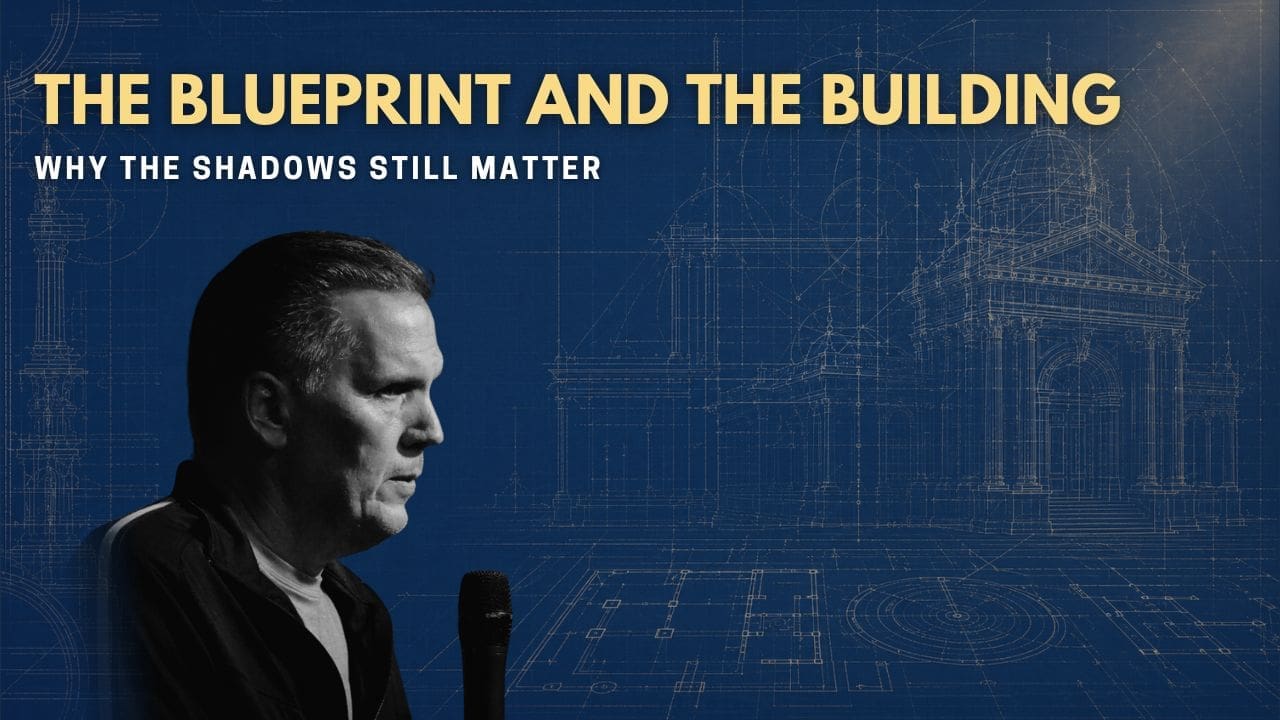
Why the Shadows Still Matter
Message by Chris Berglund/Notes by Leah Ramirez
There is a difference between admiring the blueprint and becoming the building. Scripture gives us both.
Throughout the Old Testament, God concealed the mystery of His Son in shadows, patterns, creatures, materials, priesthoods, sacrifices, feasts, and tabernacles. The lamb, the seed, the vine, the bread, the water, the altar, the priest, and the king were all revealing something that already existed in the heart of God.
The shadows did not create the substance. The substance came first.
Christ was not an afterthought attached to the imagery of Scripture. Everything was created through Him and for Him. Creation itself became a portrait through which the Father could reveal His Son.
This is why the shadows still matter.
The Substance Does Not Erase the Shadow
It is sometimes said that because Jesus is the substance, we no longer need to study the shadows. But the New Testament itself does not treat them this way.
After the death, burial, resurrection, and ascension of Jesus, the writer of Hebrews continued to explore the tabernacle, the sacrifices, the priesthood, and Melchizedek. The apostles did not discard these patterns once Christ appeared. They returned to them because the light of Christ enabled them to see what had always been hidden there.
When John saw Jesus approaching, he did not merely say, “Behold Jesus.” He declared, “Behold, the Lamb of God.”
Why invoke the shadow when the substance was standing directly in front of him?
Because the lamb reveals something about the Son.
A lamb has no claws, venom, speed, armor, or natural defense. Its safety is found in the shepherd. It knows the shepherd’s voice and follows without creating its own path. Its apparent weakness becomes a picture of surrender, trust, and dependence.
The lamb was not randomly selected and later compared to Christ. It was formed in the wisdom of God to reveal Him.
The same is true of the seed. A seed disappears into the earth. Its life is hidden before it is manifested. Within something small and seemingly insignificant lies the potential for a tree, a harvest, or even a forest.
We can look at a seed and see only a seed, or we can behold it long enough to see the mystery of Christ.
The shadows are not substitutes for Jesus. They are invitations to see Him more clearly.
Melchizedek and the Finished Work
Melchizedek appears briefly in Genesis 14, yet the writer of Hebrews spends considerable time unveiling the significance of his priesthood.
Abram had just returned from battle when Melchizedek came to meet him. He did not demand that Abram build an altar. He did not ask Abram to prove his devotion or require him to climb a mountain in search of God.
He came carrying bread and wine.
This order matters.
Melchizedek reveals a priesthood that begins with what God provides, not with what humanity offers. He comes to the exhausted man after the battle and places the finished work before him: bread and wine, life given, communion offered.
God comes to Abram before Abram attempts to come to God.
This is the architecture of the gospel. We do not offer something to God so that He will offer something to us. He gives us His life, and because we have received His life, we have something to give.
The priesthood of Melchizedek reveals Christ as the eternal Priest-King whose ministry does not begin with human sacrifice, religious striving, or separation. It begins with communion.
The Tabernacle Was Always About Participation
Every part of the tabernacle reveals Christ, but it does more than point toward Him. It reveals our participation in Him.
Jesus is the gate, but we are invited to enter. Jesus is the Lamb upon the altar, but Romans 6 tells us that we died with Him. Jesus is the cleansing water, but we are invited into the washing and renewing of our minds. Jesus is the bread of the Presence, but we are invited to eat and receive His life as our own.
Jesus is the light, yet He tells His people, “You are the light of the world.” Jesus is the fragrant offering, yet Paul says that we have become the fragrance of Christ. Jesus is seated in heavenly places, yet we have been seated with Him.
The shadows reveal more than what Jesus accomplished for us. They reveal what He has invited us to participate in with Him.
This is not merely a gospel of observation. It is a gospel of union, communion, and participation.
The Blueprint of the Apostles
Paul described himself as a wise master builder—an architect laying a foundation upon which others would build. That foundation was not human effort, moral improvement, or a list of religious commands. The foundation was Jesus Christ and His finished work.
To understand how the apostles built upon that foundation, it helps to understand the difference between an indicative and an imperative.
An indicative is a statement of fact. It tells us what is true, what has happened, or who we are. In the New Testament, the indicative often declares what Christ has already accomplished and what is now true of us because we are in Him.
An imperative is a command. It tells us how to live, what to do, or how to respond.
The order is essential. The apostles consistently established the indicative before giving the imperative. They first declared what Christ had done, who we had become in Him, and what was already true through His death, burial, and resurrection. Only then did they tell believers how to live.
You died with Christ. Therefore, do not let sin reign.
You are alive to God. Therefore, present yourself to Him.
Christ lives in you. Therefore, walk by the Spirit.
You are in Christ. Therefore, abide in Him.
The command does not create the identity. The identity makes obedience possible.
When we reverse the order, we build an architecture of striving. We tell people to be holy without first revealing that the Holy One lives within them. We tell them to become righteous without revealing that righteousness has been given as a gift. We command them to produce fruit without first teaching them to abide in the Vine.
We urge people to overcome sin through discipline, accountability, effort, and willpower without first declaring that the old humanity was crucified with Christ.
The building blocks may be true, but when they are placed upon the wrong foundation, the entire structure becomes distorted.
Holiness is real. Righteousness is real. Prayer, fasting, obedience, sacrifice, and discipline are all real. But they are not the foundation. They are the expression of Christ’s life within us.
We are not holy because we have succeeded in doing holy things. We do holy things because the Holy One lives within us.
From Independence to Dependence
Religious striving trains us to initiate. We decide what should be done for God, and then we ask Him to bless it. We choose what to pray, determine how much to fast, and look at what others are doing until we feel pressure to produce something equally significant.
We measure our lives against missionaries, ministers, intercessors, and leaders. But the life of Christ is not lived through comparison. It is lived through response.
The Father initiates. The Son reveals. The Spirit leads. We respond.
The question is not merely, “What can I do for God?” The deeper question is, “What is in the heart of God that He desires to express through me?”
God places a portion of His own desire within His people. What we sometimes call our calling is actually something from His heart entrusted to us for manifestation in the earth.
We are not inventing a purpose and inviting Him into it. We are being invited into His life.
This frees us from the crushing pressure to perform for God. We begin to pray because Christ is interceding within us. We fast because His grace is empowering surrender. We serve because His love is moving toward someone.
We labor, yet we recognize with Paul that it is not ultimately us, but the grace of God working within us.
This is dependence. It is not passivity or inactivity. Dependence is the active participation of a surrendered life.
The Goal of Apostolic and Prophetic Ministry
The New Testament prophet is not meant to recreate an Old Testament hierarchy in which one person hears God and everyone else depends upon that voice.
At Pentecost, the fire that once rested upon the Holy of Holies divided and rested upon every person. This was because every believer had become a dwelling place, every believer had become a temple, and every believer had been invited to hear the voice of the Shepherd.
This is why apostolic and prophetic ministry must equip the body rather than replace it. The purpose of fivefold ministry is not to create spiritual dependency upon gifted leaders. It is to bring the people of God into maturity and the full stature of Christ.
The highest function of prophetic ministry is not merely to announce what God is saying. It is to awaken a priesthood that communes with Him.
God’s desire has always been a priestly people: a people who hear, a people who behold, a people who know His heart, and a people through whom His Son can be revealed.
The Building God Is Forming
The Church at the end of the age cannot be built upon stories of what God did twenty or thirty years ago. It must participate in the life of Christ now.
It cannot be built upon apostolic titles, prophetic personalities, human strength, triumphalism, comparison, or self-appointed assignments. It must be built upon the finished work of Jesus.
It must begin with the indicative. It must begin with what Christ has already accomplished. It must begin with union.
From that foundation, God is forming a people who do not merely speak about Jesus but manifest His life. They do not simply admire the blueprint; they become the building. They do not discard the shadows but allow the light of Christ to illuminate them.
They can look at the lamb, the seed, the bread, the wine, the water, the vine, the priesthood, and the tabernacle and declare: This is Christ, and because we are in Christ, this is our invitation.
Let the Scaffolding Fall
Many of us have spent years within religious structures built upon the imperative.
Do more. Pray harder. Fast longer. Try again. Become worthy. Prove your devotion. Earn greater access.
But the Father is dismantling the old scaffolding. He is removing the lenses that taught us to begin with ourselves. He is recovering the gospel of His Son.
This dismantling can be painful because the architecture of striving often feels familiar. It may even feel safe. We know how to measure effort, compare performance, and judge progress by visible activity.
Dependence requires surrender. It requires us to trust the life of Another within us.
But this is the building God desires—not a monument to human devotion, but a habitation for His Son.
May every false foundation be shaken. May every structure built upon self-effort come down. May every shadow be illuminated in the face of Christ. May we begin and end in the finished work of the cross.
And may Jesus receive what He has always desired: a people in whom He can live, move, and have His way.
Jesus, you are the Lamb. You are the Bread. You are the Wine. You are the Vine. You are the Water. You are the High Priest forever.
Live Your life in us. Live Your life through us.
And let the gospel of Your Son remain.
Stay Connected
Watch the Message
The Blueprint and the Building | Why the Shadows Still Matter
Give
Partner with The Gathering
Join Company 318 on Substack
Subscribe to Company 318
Come Visit Us
Plan Your Visit to The Gathering
We gather every Sunday at 10:00 a.m. at 720 Elkton Drive, Colorado Springs, CO 80907.
The Blueprint and the Building
Leave a Reply Cancel reply

THE GATHERING
A local church and teaching community in Colorado Springs.
Sundays at 10:00 a.m.
720 Elkton Dr.
Colorado Springs, CO 80907
EXPLORE
LIFE TOGETHER
WIDER COMMUNITY
SUPPORT & CONTACT
About The Gathering
Leah Ramirez
Chris Berglund
Teaching
Reflections / Blog
Devotionals
Small Groups
Beholding and Prayer
The Grove
Planted Youth
Company 318
Behold School
Latest Teaching
YouTube
Facebook
Give
Contact Us
info@the-gathering.us
407-340-0204
@ 2026 The Gathering
What We Believe
Waic Up Call - Y.A.
The Vine - Kids