
July 6, 2026
What do we believe Jesus intends to become through His people?
That question may be one of the most important questions before the Church right now.
We often talk about eschatology — the end of the age, the increase of darkness, the shaking of nations, the return of Christ. But our view of the end is deeply connected to our view of the Church. In other words, our ecclesiology shapes our eschatology.
Ecclesiology is simply the study of the Church — but not the Church as an institution, brand, weekly gathering, or religious service. Ecclesiology asks a much deeper question:
Who is the Ekklesia?
Who are we, really, in Christ?
Are we a passive people waiting to be rescued from a darkening world? Are we an ambitious people trying to build something for God and asking Him to bless our plans? Or are we a people in union with Christ, hearing His voice, seated with Him, and being sent into the earth as obedient sons?
This is the war of the world.
Not first a war over politics, culture, systems, or headlines.
The deepest war is over habitation.
Will Christ have a people through whom He can express His heart, His authority, His wisdom, His mercy, and His victory in the earth?
The Priesthood Begins at the Finished Work
When Melchizedek appears in Scripture, he does not come with an altar. He does not come with sacrifice. He comes with bread and wine.
That is stunning.
The Melchizedek priesthood does not begin with endless sacrifices, endless striving, and unfinished work. It begins at the finished work. It begins with communion. It begins with union. It begins with participation in the life of Another.
The Levitical priesthood was marked by repetition. Sacrifice after sacrifice. Offering after offering. The work was never done. There was no seat in the holy place because the priest’s labor was never finished.
But Jesus, our great High Priest, sat down.
The finished work of Christ is not merely something we believe happened for us. It is the place we now live from. We enter into Him. We participate in His life. We abide in Him, remain in Him, eat His flesh, drink His blood, and become one with Him.
Hebrews defines the Melchizedek priesthood.
John describes it.
John may not use the phrase “Melchizedek priesthood,” but he gives us its inner life: abiding, remaining, communion, union, oneness, participation.
This invitation into the Melchizedek priesthood is not merely about loving God from a distance. It is about becoming a dwelling place from which His heart can be extended.
The Church Was Never Meant to Be Passive
There is a version of Christianity that reads Matthew 24 and concludes: everything is going to get darker, Jesus is going to rescue us, and the Church simply needs to hold on until He returns.
But we cannot build our entire ecclesiology from one isolated passage while ignoring the rest of the witness of Scripture.
Jesus said, “I will build My Church, and the gates of Hades shall not prevail against it.” He also said, “All authority has been given to Me in heaven and on earth. Therefore go.”
Romans 8 says creation is groaning for the revealing of the sons of God.
Romans 16 says the God of peace will crush Satan under our feet.
Ephesians 1 says the Church is His body, the fullness of Him who fills all in all.
Ephesians 3 says that through the Church the manifold wisdom of God is made known to principalities and powers.
Ephesians 4 says the body grows into mature manhood, into the measure of the stature of the fullness of Christ.
Ephesians 5 says Christ will present to Himself a glorious Church.
Hebrews 12 says everything shakable will be shaken, but we are receiving an unshakable Kingdom.
Revelation 12 says the saints overcome by the blood of the Lamb, the word of their testimony, and loving not their lives unto death.
Revelation 2 and 3 promise authority, white garments, hidden manna, the morning star, and the right to sit with Christ on His throne to those who overcome.
This does not sound like a weak Church.
This sounds like a people who have been invited into the victory of Christ.
Not Triumphalism — Obedient Union
Of course, there is a counterfeit.
There is a version of “victorious Christianity” that is full of pride, presumption, self-promotion, and ego. It tries to do things for God and then asks Him to stand with what we have decided.
That is not the way of Jesus.
Jesus said, “The Son can do nothing of His own accord, but only what He sees the Father doing.”
That is the key.
The authority of the Ekklesia is not arbitrary. It is not whatever we feel like declaring. It is not using spiritual language to crown our own ambition.
True authority flows from union.
We behold Him.
We abide in Him.
We are seated with Him.
We are sent by Him.
That sequence matters.
Behold. Abide. Be seated. Be sent.
We do not move from striving. We do not move from fear. We do not move from presumption. We move because we have heard His voice and are participating in His heart.
This is why the Church must recover a biblical understanding of participation. Throughout Scripture, God continually invites His people into what He is doing.
He tells Noah to build the ark.
He tells Moses to stretch out his rod.
He tells Joshua to command the sun and moon to stand still.
He tells Elijah to speak concerning the rain.
He tells Ezekiel to prophesy to the wind.
Again and again, God does not simply say, “Stand back and watch Me do everything.”
He invites His people to participate.
At the Red Sea, the Lord says to Moses, “Why do you cry to Me? Tell the people of Israel to go forward. Lift up your staff, and stretch out your hand over the sea and divide it.”
There is a kind of prayer that is actually avoidance.
“God, do something.”
And the Lord says, “I have given you authority. I have put the rod in your hand. Now move with Me.”
Priests Carry Names, Not Accusations
If we are going to recover the authority of kings, we must also recover the heart of priests.
The high priest carried the names of the tribes of Israel on his shoulders and over his heart. He did not enter the holy place carrying a list of their sins. He carried their names.
That matters.
The priest is a burden bearer. He carries the people before the Lord. He carries their calling, their identity, their restoration, and their destiny.
It is easy to see sin.
It is easy to identify failure.
It is easy to become an accuser.
But the priest asks a deeper question: Who was this person intended to be? What name did God speak over them? What calling is buried beneath the ashes of their failure?
In Zechariah 3, Joshua the high priest stands before the Lord in filthy garments, and Satan stands there to accuse him. The accusation may have been true, but heaven’s response was not agreement with the accuser. The Lord commanded that Joshua’s filthy garments be removed and that he be clothed in clean robes.
There must be a restoration inside our discernment.
If we see sin but do not carry the person on our heart, we are not functioning as priests. If we expose without interceding, accuse without weeping, and critique without carrying, we have departed from the heart of Christ.
Jesus knew Peter would deny Him.
And He said, “I have prayed for you.”
That is priesthood.
Creation Is Groaning for Mature Sons
This is not theology for theory’s sake.
This is about how we respond to real suffering, real crisis, and real need.
As fires burned across Colorado, the question became painfully practical: What does it mean for the Ekklesia to carry a region on its heart? What does it mean to stand as priests and kings, not detached from the suffering of our neighbors, but participating with the heart of God for the land, the people, the firefighters, the families, and the homes at risk?
We are not called to pray careless prayers. We are not called to presume. We are not called to perform.
We are called to listen.
Even in praying for weather, we need the wisdom of God. A summer downpour in Colorado can bring lightning, wind, and flash flooding. What is needed may be something unexpected — mist, overcast skies, no wind, even something as unusual as snow.
The point is not to manufacture a dramatic prayer.
The point is to hear the Lord.
What is He saying?
Where is faith rising?
What is the invitation?
Sometimes the greatest shift in prayer comes when we stop approaching God only as beggars and begin to hear His invitation: “Let us do this together.”
Not apart from Him.
Not instead of Him.
With Him.
In Him.
From Him.
Is God Waiting on Us?
There is a haunting question here.
Could it be that in some areas we are not waiting on God as much as God is waiting on us?
Waiting for us to understand who He is in us.
Waiting for us to stop thinking of ourselves as worms.
Waiting for us to stop pretending we are God.
Waiting for us to awaken to union.
Waiting for us to become mature sons.
Waiting for us to carry His heart into the earth.
Waiting for a people who will say yes.
The Church is not called to be passive in the face of darkness. But neither are we called to be presumptuous in the name of victory. We are called to be a people so joined to Christ that His voice becomes clear, His heart becomes ours, and His authority moves through surrendered sons and daughters.
This is the war of the world.
Will Christ have a visible Ekklesia through whom He can make His manifold wisdom known?
Will He have a priesthood who carries names instead of accusations?
Will He have a people who behold, abide, sit, and are sent?
Will creation see the revealing of the sons of God?
May we be found as those who say yes.
Watch the full message here:
https://www.youtube.com/live/iL4G0BBoUG8?si=P0CW6sxwu63JSu29
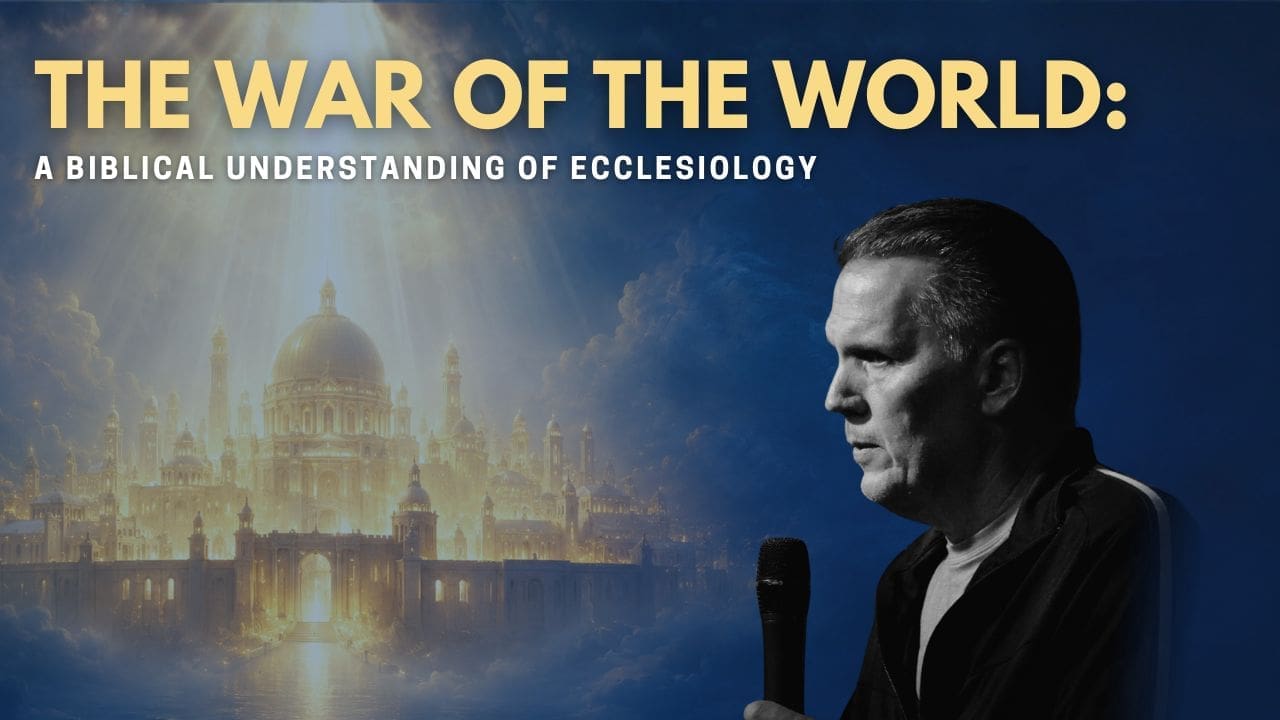
The War of the World: A Biblical Understanding of Ecclesiology
Leave a Reply Cancel reply

THE GATHERING
A local church and teaching community in Colorado Springs.
Sundays at 10:00 a.m.
720 Elkton Dr.
Colorado Springs, CO 80907
EXPLORE
LIFE TOGETHER
WIDER COMMUNITY
SUPPORT & CONTACT
About The Gathering
Leah Ramirez
Chris Berglund
Teaching
Reflections / Blog
Devotionals
Small Groups
Beholding and Prayer
The Grove
Planted Youth
Company 318
Behold School
Latest Teaching
YouTube
Facebook
Give
Contact Us
info@the-gathering.us
407-340-0204
@ 2026 The Gathering
What We Believe
Waic Up Call - Y.A.
The Vine - Kids