
June 30, 2026
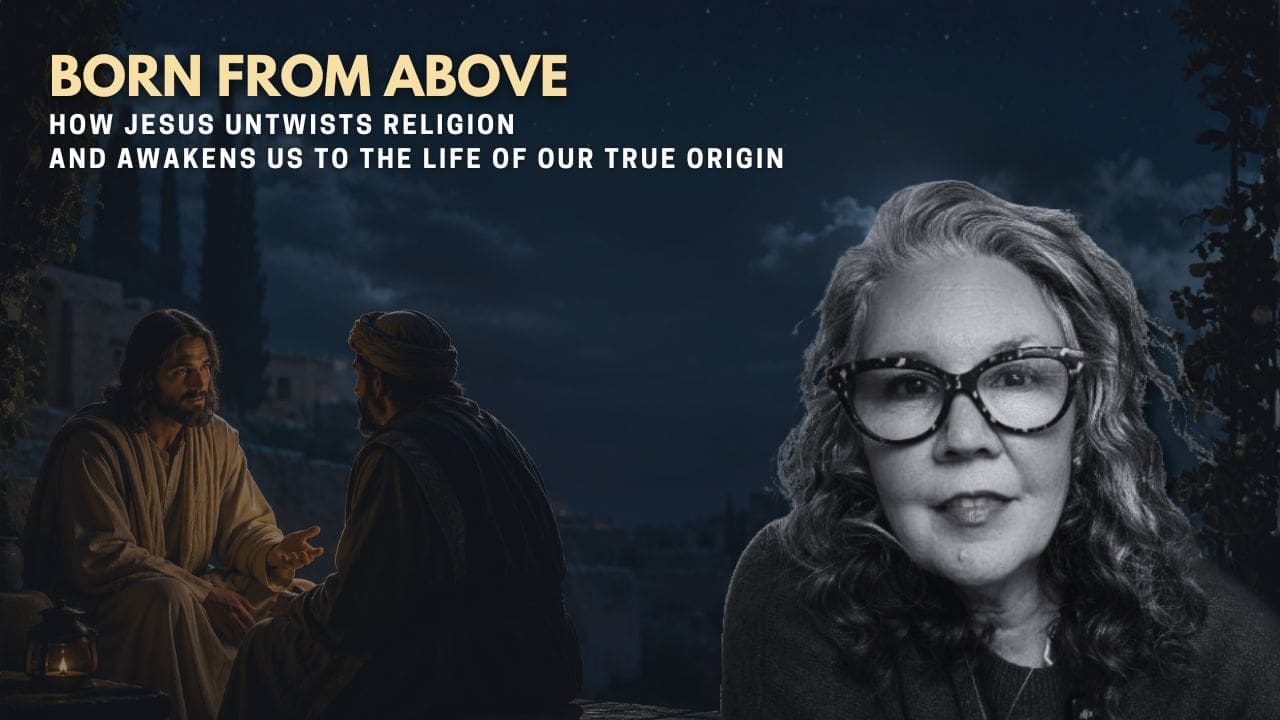
How Jesus Untwists Religion and Awakens Us to Our True Origin
Leah Ramirez
There are passages we think we know so well that we almost stop hearing them.
John 3 is one of those passages for many of us. Nicodemus comes to Jesus at night, recognizes something of God in Him, and Jesus says the famous words most of us have heard translated this way: “Unless one is born again he cannot see the kingdom of God.”
And if we are honest, many of us have heard that as a kind of immediate correction.
Almost like Jesus is saying, “Nicodemus, you don’t get it. You are not even in unless you are born again.”
But what if Jesus is doing something far more beautiful?
What if the Master Evangelist is not beginning by shaming Nicodemus for what he cannot see, but by validating the light that brought him there in the first place?
Nicodemus says:
“We know that you are a teacher come from God, for no one can do these signs that you do unless God is with him.”
— John 3:2
And Jesus answers:
“Truly, truly, I say to you, unless one is born again he cannot see the kingdom of God.”
— John 3:3
But the Greek phrase there is γεννηθῇ ἄνωθεν — genēthē anōthen.
That word anōthen can mean “again,” but it also means “from above.” This is why some translations render John 3:3 as “born again,” while others render it “born from above.” The NET Bible even notes that the Greek word can carry both meanings, which helps explain Nicodemus’s misunderstanding about entering his mother’s womb a second time.
But in John’s Gospel, “from above” is a very strong reading.
John uses this same word in John 3:31:
“He who comes from above is above all.”
And again in John 19:11, when Jesus tells Pilate:
“You would have no authority over me at all unless it had been given you from above.”
John also uses it in John 19:23 to describe Jesus’ tunic as woven “from the top” throughout.
So when Jesus speaks to Nicodemus, He is not simply introducing a religious category called “born again.” He is speaking about origin. Source. Sight. Spirit. Heaven. The reality of a life that begins in God.
In other words, Jesus may be saying something like this:
“Nicodemus, you would not even be able to recognize Me as having come from God unless there was already something in you that belonged to God. The very fact that you can perceive something of My origin means heaven is already pressing upon your sight.”
That changes the whole conversation.
Jesus is not saying, “Try harder to become something.”
He is saying, “You cannot see this from below.”
This is not a ladder.
This is an unveiling.
Religion Forgets Origin
Religion always forgets origin.
It begins with the fall, the failure, the distortion, the behavior, the distance, the separation. It becomes obsessed with what went wrong.
But Jesus comes to reveal what was true before anything went wrong.
John opens his Gospel this way:
“In the beginning was the Word, and the Word was with God, and the Word was God… All things were made through him, and without him was not any thing made that was made. In him was life, and the life was the light of men.”
— John 1:1–4
All things were made through Him.
That means before there was sin, there was design.
Before there was distortion, there was image.
Before there was shame, there was breath.
Before there was hiding, there was face-to-face communion.
The fall did not create humanity. God did.
The fall twisted us.
But Christ created us.
And the Gospel is not merely the announcement that God has figured out a way to tolerate fallen people. The Gospel is the unveiling of the Son, through whom all things were made, coming into His own creation to rescue, restore, and reveal what we were made for all along.
John 1 continues:
“The true light, which gives light to everyone, was coming into the world.”
— John 1:9
That verse has been working in me.
The true light gives light to everyone.
This does not mean everyone is automatically living awake to that light. John is very clear: the world was made through Him, and yet the world did not know Him. His own did not receive Him.
But it does mean that when I encounter another human being, I do not begin with the assumption that Christ is absent.
They could not have been made without Him.
So my prayer is not, “God, go into that life.”
He is already the One through whom they exist.
My prayer becomes, “Lord, unveil the light. Tear the veil. Awaken them to the One who has been nearer than they knew.”
This is how Jesus deals with Nicodemus.
Nicodemus comes in the dark, but Jesus does not despise the small measure of light that brought him there. He regards it. He reframes it. He reveals its source.
“You could not even recognize Me unless your seeing had its source from above.”
The Womb-Climbing Ritual
Nicodemus immediately misunderstands.
“How can a man be born when he is old? Can he enter a second time into his mother’s womb and be born?”
— John 3:4
This is what religion does.
When Jesus speaks from above, religion turns the invitation into a technique.
Nicodemus essentially invents a new ritual on the spot: womb-climbing.
He hears heavenly language and immediately tries to process it through an earthly religious framework.
“What do I have to do?”
“What act do I perform?”
“What ritual gets me in?”
“What ladder do I climb?”
“What requirement do I satisfy?”
But Jesus is not giving Nicodemus a self-rebirth technique.
Flesh cannot produce Spirit.
Earthly categories cannot generate heavenly sight.
Religious effort cannot manufacture life from above.
Jesus says:
“That which is born of the flesh is flesh, and that which is born of the Spirit is spirit.”
— John 3:6
This is not Jesus despising the body or rejecting humanity. This is Jesus contrasting realms of source and perception. Flesh cannot generate Spirit. Human will, religious status, and earthly striving cannot produce kingdom sight.
Spirit gives birth to spirit.
The new birth is not primarily a human achievement. It is the Spirit’s unveiling of our true life and origin in Christ, so that what is objectively true in Him becomes consciously received, trusted, and embodied in us.
Jesus is inviting Nicodemus beyond sign-level recognition into kingdom perception.
Not just: “God is with You.”
But: “You are from above.”
And eventually this whole conversation opens into one of the most beloved declarations in Scripture:
“For God so loved the world, that he gave his only Son…”
— John 3:16
Not God so loved the religious.
Not God so loved the already-aware.
Not God so loved the ones who had all their theology right.
God so loved the world.
The entire cosmos is the object of His affection.
The Gospel Has a Sound
I have been thinking so much about the Gospel lately.
Not the talking points of the Gospel.
Not the tract version.
Not the religious outline that somehow manages to speak of sin, punishment, decision, and heaven without ever sounding like good news.
The Gospel has a sound.
It is the unexpected liberty of God.
It is grace incarnate coming into the room and changing the whole lens of our lives.
It is Jesus standing in front of a religious man who came under the cover of night and saying, in essence:
“You are more than the darkness you came in. You are more than the religious system that formed you. You are more than your misunderstanding. You are more than the veil over your heart. I know where you are from, Nicodemus. You are from above, and I have come to awaken you.”
This is why John 3 is not a flat evangelism script.
It is a wonder.
Jesus is not cold-cocking Nicodemus with a theological correction. He is drawing him. He is letting the conversation expose the limits of Nicodemus’s religious lens, but He is not abandoning him there.
And we know Nicodemus’s story does not end in John 3.
He shows up again.
The conversation kept working in him.
Jesus is willing to let us bump up against the limits of our own lens, because He knows the light has already begun its work.
Loophole Living
I recently watched a video about a religious Jewish community where there was a thin line, almost like a fishing line, stretched around a whole neighborhood. It was an eruv, a boundary used in some Sabbath observance practices.
The idea was that within that boundary, the area could be treated like one household, allowing people to carry certain things on the Sabbath without technically violating the command.
And I remember thinking: this is what religion does.
It finds a loophole.
It says, “How can I technically keep the law while still carrying what I want to carry?”
And before we turn that into a critique of someone else’s religion, we should let it expose ours.
Because Christians do this too.
We ask:
“How close can I get to the line without breaking covenant?”
“How far can I go before it is sin?”
“Is this gossip or just processing?”
“Is this lust or just looking?”
“Is this compromise or just freedom?”
“Am I technically still okay?”
But if our whole spiritual life is spent staring at the boundary line, we are missing the life of the covenant.
This is not to say there are no boundaries. There are. Covenant has a real boundary. Love has a shape. Marriage has a boundary. Holiness has substance. Sin destroys.
So should we go on sinning?
By no means.
But the point of the Gospel is not to make us expert loophole-makers. The point is not to help us build a religious fishing line around our lives so we can carry what we want while technically staying within the rules.
The point is life.
The point is union.
The point is rest.
The Sabbath command was never about figuring out how far you could walk while still calling it obedience. It was an invitation into the rest of God.
And this is where religion misses the whole spirit of the thing.
It keeps the rule and misses the joy.
It guards the line and misses the Person.
It preserves the structure and misses the life.
Jesus did not come to make us better loophole managers.
He came to awaken us to life from above.
The Life Is in the Son
This matters because so much of the Church has become sin-conscious rather than Son-conscious.
And I know that can sound dangerous to a religious ear.
When you say, “We are not called to be sin-conscious,” someone immediately hears, “So we can just go on sinning?”
By no means.
But the answer to sin is not obsession with sin.
The answer to sin is Christ.
The life is in the Son.
If we are always staring at the line, trying to determine whether we are just inside or just outside the boundary, we have not yet learned the life of the covenant.
Imagine a marriage where the whole conversation is:
“How close can I get to betrayal without technically breaking my vows?”
That is not covenant love.
That is loophole living.
The joy of marriage is not found in obsessing over how near we can get to the line. It is found in turning toward the beloved.
The same is true in Christ.
Holiness is not primarily distance from a line.
Holiness is nearness to a Person.
When we behold Him, we become like Him.
When we remember our origin in Him, we stop trying to become through effort what we were created to receive by communion.
Learning to See People From Above
This changes evangelism too.
I have been experiencing this in real life.
There is a young woman who teaches one of my exercise classes. She is probably around my daughter’s age, and I have felt such a supernatural love for her. Over the last few weeks, we have struck up conversations after class. She has shared pieces of her faith journey, including how she came out of religion and could not seem to find God in it.
She is searching. She is seeking. And she is also into some things many Christians would immediately feel the need to correct.
But as I listened to her, I kept sensing the Lord say, “Do not say a word. Just listen. Draw her journey out.”
And I realized: this is part of the Gospel too.
Not the need to correct every place a person is wrong the moment they reveal it.
But the willingness to recognize the light that brought them into the conversation.
Jesus touched lepers.
Jesus moved toward the unclean.
Jesus was not afraid of being defiled by people’s process.
We are the ones who build cabins in the woods and hide from the darkness.
But Jesus says, “You are the light of the world.”
And the darkness cannot overcome the light.
So I sat with her. I listened. She shared for a long time. And at the end of the conversation, she hugged me. What came out of my mouth was, “I just adore you.”
And I meant it.
I could feel the door of her heart open.
Not because I corrected everything.
Not because I gave her a religious script.
Not because I managed the conversation perfectly.
But because love recognized origin.
This is how Jesus evangelizes Nicodemus.
He does not begin by saying, “Let Me tell you everything wrong with you.”
He says, “The reason you can recognize Me at all is because you too are born from above.”
He sees the design beneath the distortion.
And if we are going to carry the Gospel rightly, we must learn to see people this way too.
The Invitation
John 3 is inviting us to look again.
Maybe Jesus was not saying what we thought He was saying.
Maybe He was not beginning with exclusion, but with unveiling.
Maybe He was not giving Nicodemus a new religious hoop to jump through, but inviting him out of earthly religious perception into Spirit-born recognition.
The question is not merely, “Have you performed the correct ritual?”
The deeper question is:
Can you see Him?
And as you see Him, can you let Him show you who you really are in Him?
You did not begin in the fall.
You began in the heart of God.
You were made through Christ and for Christ.
You were created for union.
You were made for face-to-face communion.
You were made to live from above.
The veil is real, but the veil is not your design.
Sin is real, but sin is not your origin.
Religion is powerful, but religion is not your source.
Christ is your source.
And He has come to untwist us.
He has come to raise us up.
He has come to awaken us to the life we were made for all along.
So this week, sit with John 3 again.
Read the conversation slowly.
Listen for the sound of the Gospel.
Watch Jesus, the Master Conversationalist, meet a religious man in the dark and draw him toward the light.
And maybe, as you behold Him, you will hear the invitation too:
You are not from below.
You are born from above.
Watch the Full Teaching
Born From Above | How Jesus Untwists Religion and Awakens Us to Our True Origin | Leah Ramirez
Rewatch here: https://www.youtube.com/live/F38oLz5_qgg?si=4TX7OHPwXRTZ6kdz
Stay Connected
Visit The Gathering
Sundays at 10:00 a.m.
720 Elkton Dr.
Colorado Springs, CO 80907
https://the-gathering.us
Give to The Gathering
https://the-gathering.us/give
Get Weekly Updates
https://form.jotform.com/The_Gathering_COS/lets-get-connected
Join Company 318
https://the-gathering.us/company-318
Subscribe on Substack
https://company318.substack.com
Get Leah’s Devotional: Re-Found — 30 Days to Rediscover the Gospel
https://the-gathering.us/re-found-devotional
Leah Ramirez Website
https://leahramirez.com
Born From Above
Leave a Reply Cancel reply

THE GATHERING
A local church and teaching community in Colorado Springs.
Sundays at 10:00 a.m.
720 Elkton Dr.
Colorado Springs, CO 80907
EXPLORE
LIFE TOGETHER
WIDER COMMUNITY
SUPPORT & CONTACT
About The Gathering
Leah Ramirez
Chris Berglund
Teaching
Reflections / Blog
Devotionals
Small Groups
Beholding and Prayer
The Grove
Planted Youth
Company 318
Behold School
Latest Teaching
YouTube
Facebook
Give
Contact Us
info@the-gathering.us
407-340-0204
@ 2026 The Gathering
What We Believe
Waic Up Call - Y.A.
The Vine - Kids