
November 23, 2026
Union with Christ, abiding in Jesus, and the invitation to participate in His life.
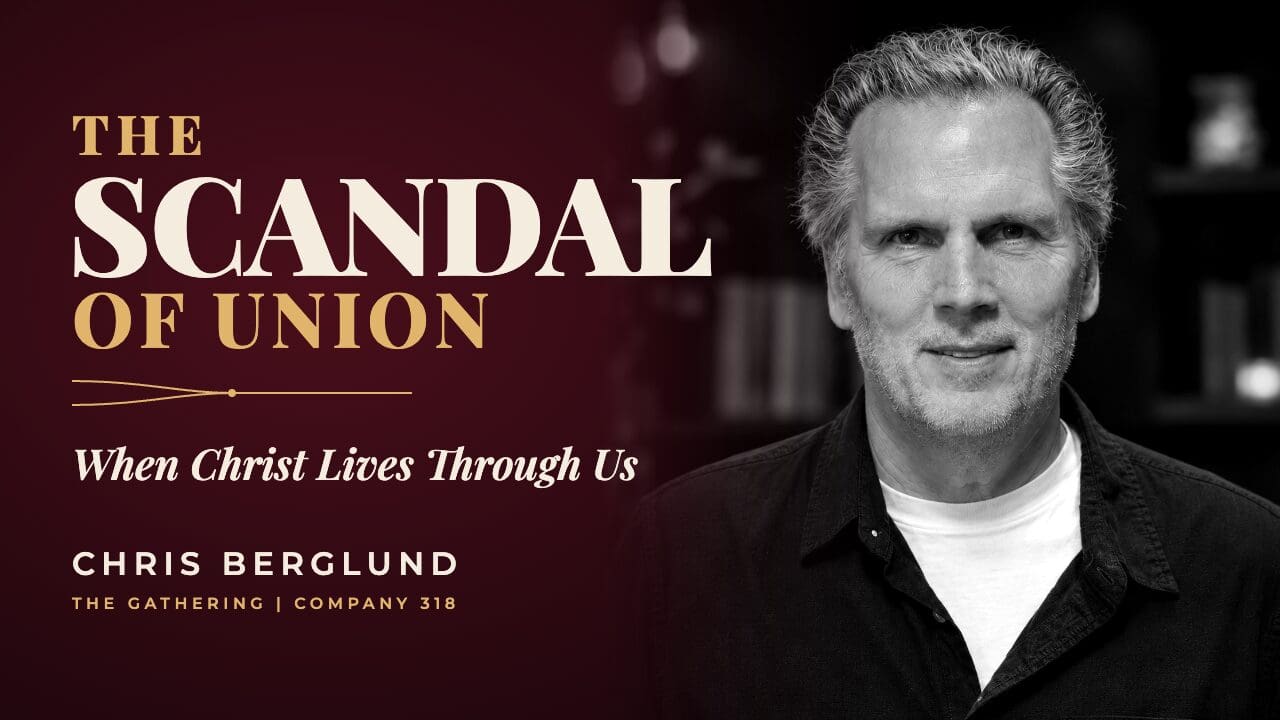
A teaching from Chris Berglund and The Gathering in Colorado Springs | November 22, 2026
What if the Christian life was never intended to be our attempt to become great for God, but the revelation of His greatness through us?
There is something deeply challenging about the Gospel of union with Christ. We have spent so much of our Christian lives measuring maturity by what we accomplish, how faithfully we serve, or how effectively we fulfill the responsibilities placed before us. Even our understanding of spiritual greatness has often been shaped by the same patterns of achievement and recognition that govern the world around us.
But Jesus introduced us to an entirely different life. He did not come simply to improve our religious performance or give us a higher standard to pursue. He came to bring us into His own relationship with the Father, to share His life with us, and to make us participants in all that He is doing.
Through some surprising stories in the book of Judges, the testimony of Hebrews 11, and the priestly imagery of the Old Covenant, Chris Berglund opened up something in Sunday’s teaching that changes the way we understand faith, prayer, ministry, and even the purpose of the Church.
Union with Christ does not eliminate our participation. It eliminates our independence.
And perhaps that is where much of our religious thinking begins to come undone.
The Longing for Greatness
Chris began by recalling a conversation years ago about the longings of the human heart. One of those longings had been described as the desire to be great. He found himself disagreeing with the premise, and the conversation apparently did not go particularly well.
His concern was not with the desire for a meaningful life or the longing to see something extraordinary accomplished. It was with the assumption that greatness is something we are meant to possess independently of Christ.
We recognize this tendency in the disciples who wanted to know which of them would be greatest. They were following Jesus, listening to His teaching, and witnessing the Kingdom of God break into the world, yet they were still imagining a future in which their individual significance would be established.
How easily we carry that same imagination into our understanding of ministry. We want to be powerful, influential, effective, and fruitful. We may genuinely desire to see people healed, delivered, and reconciled to God. Yet somewhere along the way, we can begin to measure the importance of our lives by the visible greatness of what happens through us.
The Gospel offers us something far more wonderful than personal greatness. It reveals that Christ Himself has become our life.
Paul calls this mystery “Christ in you, the hope of glory” (Colossians 1:27). The glory we were created for is not found in our ability to distinguish ourselves from one another. It is found in our participation in the Son, through whom the Father is making Himself known.
Jesus describes Himself as the vine and us as the branches in John 15. The branch bears fruit, but the life producing that fruit belongs to the vine. There is no independent greatness to be found in the branch, yet neither is the branch insignificant. It has been given the extraordinary privilege of bearing the life of another.
The longing for greatness is transformed as we begin to see ourselves this way. We want His life to be revealed, and we rejoice wherever that revelation appears.
Participation Is Not a Transaction
One of the great distortions of religious thinking is the assumption that God is waiting for us to accomplish something that will finally persuade Him to act.
We see this in the ways we have sometimes approached prayer and fasting. If we pray long enough, fast intensely enough, or demonstrate sufficient commitment, perhaps God will finally release His power. Without realizing it, we can begin treating our spiritual disciplines as a means of negotiating with Him.
Chris shared a testimony from Bobby Conner about a wildfire in Montana. According to Bobby’s account, after reading about the devastation, he began asking the Lord what He intended to do. What followed was an unusual series of instructions and confirmations that eventually led Bobby to travel to the area and declare what he believed God had spoken. An unexpected snowstorm reportedly came through and extinguished the fire.
What interested Chris about the testimony was not the unusual nature of the miracle. It was the relationship between God’s initiative and human participation.
Bobby had not originated the desire to extinguish the fire, nor did he possess some independent power over the weather. He believed he had heard something from the Lord, and he responded.
Paul planted, Apollos watered, and God gave the growth. Paul describes himself and Apollos as God’s fellow workers in 1 Corinthians 3:9. Their participation was real, and the fruit of their labor was entirely dependent upon the life and power of God.
There is a way of teaching the finished work of Christ that can unintentionally make participation seem unnecessary. Once we have understood that Jesus has accomplished our reconciliation, secured our access to the Father, and given us His Spirit, we might conclude that there is nothing left for us to do.
But the finished work of Christ has never been an invitation to spiritual passivity. It is the very foundation of our participation.
We no longer pray to convince a reluctant God to become involved. We pray because we have been brought into communion with the Father through His Son. We no longer obey to establish our belonging. We obey because His life has become the source from which our obedience flows.
The order matters. What God has accomplished in Jesus comes first. Our participation is a response to His grace, not an attempt to produce it.
The Extraordinary Faithfulness of God
Hebrews 11 is often called the Hall of Faith, and we tend to read it as a record of extraordinary individuals whose courage, obedience, and spiritual accomplishments distinguished them from ordinary believers. Yet several of the people named in that chapter are among the most complicated characters in the Old Testament.
Consider Samson. He was called and empowered by God, yet his story is filled with impulsive decisions, compromised relationships, and devastating personal failures. Gideon began his journey hiding from the Midianites, terrified of the enemy and painfully aware of his own inadequacy. Even after God brought about a remarkable deliverance through him, Gideon made decisions that brought terrible consequences to Israel.
Then there is Jephthah, whose tragic vow in Judges 11 reveals the destructive consequences of approaching God through a transactional understanding. The Spirit of the Lord had already come upon him, yet he attempted to secure the outcome of his battle by promising something God had never requested.
These stories are uncomfortable because we would prefer our heroes to be more consistent. We want the people God uses to possess the kind of character and strength that would explain why He chose them.
Yet Hebrews 11 includes these names without pretending their lives were without contradiction.
Perhaps we have been reading this chapter with our attention on the wrong person.
The great testimony of Hebrews 11 is not that human beings are capable of astonishing spiritual achievement. It is that God remains faithful, even as deeply flawed people learn to trust what He has spoken.
This does not excuse their failures or suggest that their destructive decisions were expressions of God’s will. Their stories invite us to distinguish between the faithfulness of God and the limitations of the people through whom He works.
Faith is not our ability to become sufficient for God’s purposes. It is our response to the One who is faithful.
We can spend years waiting to become confident enough, mature enough, or spiritually impressive enough to participate in what God has placed upon our hearts. Meanwhile, the very weakness we are trying to overcome may be the place where we are being invited to discover His sufficiency.
The Treasure in the Broken Vessel
Israel was facing an overwhelming enemy. The Midianites had devastated the land, stealing harvests and leaving the people impoverished and afraid. When Gideon gathered an army of 32,000 men, the Lord instructed him to reduce their numbers until only 300 remained.
God explained His purpose. He would not allow Israel to mistake the coming victory for something their own strength had accomplished.
Then came the extraordinary battle strategy recorded in Judges 7. Gideon’s men surrounded the enemy camp carrying trumpets, empty clay jars, and torches. At the appointed moment, they blew their trumpets, broke the vessels, revealed the light, and shouted. The enemy was thrown into confusion, and God brought about a victory Israel could never have secured through military strength alone.
Paul describes the treasure of God’s life being carried in jars of clay so that the surpassing power is recognized as belonging to God (2 Corinthians 4:7). There is something deeply moving about the picture of light being revealed through a broken vessel.
The weakness of the vessel does not diminish the glory of the treasure. The vessel was never intended to be the source of the light.
We are beginning to recognize how thoroughly this challenges the way we have been taught to think about Christian maturity. We have often imagined that becoming strong in the Lord means becoming increasingly capable, confident, and sufficient. Yet Paul describes a life in which weakness becomes the very place where the power of Christ rests upon us.
Gideon’s victory did not require Israel to become more impressive. It required them to believe God and participate in what He had spoken.
The Blood, the Oil, and the People Brought Near
In Exodus 29, blood was placed upon the right ear, the right thumb, and the right big toe during the consecration of the priesthood. This imagery speaks to a life set apart for God, including the hearing of His voice, the work of our hands, and the way we walk.
Chris connected this with the account of Adoni-bezek in Judges 1, whose thumbs and big toes were removed following his defeat. The loss of these parts of the body represented a profound weakening of his ability to stand, move, and exercise power.
In Leviticus 14, when a person who had suffered from leprosy was being restored, the priest applied blood and oil to the same places: the ear, the thumb, and the toe. The one who had been excluded from the community was now being cleansed and brought near.
The blood speaks of cleansing and reconciliation, while the oil points us toward the anointing and empowering presence of the Holy Spirit.
The one who had been cast out is welcomed. The one who had been separated is restored to fellowship. The one who stood outside is brought near.
And in Jesus Christ, the privilege of drawing near to God is no longer confined to a select priesthood.
Peter declares that we are a royal priesthood, a holy nation, a people belonging to God (1 Peter 2:9). Paul announces that through Christ we have access in one Spirit to the Father (Ephesians 2:18).
This is the extraordinary generosity of the Gospel. God has not established a spiritual hierarchy in which a few exceptional people enjoy a nearness that remains unavailable to everyone else. Through the blood of Jesus, the way into His presence has been opened.
We are being invited to live as sons and daughters who know their Father, hear His voice, and participate in His life.
What Does It Mean to Abide in Christ?
Jesus tells His disciples, “Abide in me, and I in you” (John 15:4, ESV).
To abide is to remain in Him, to live from the life we have received, and to recognize that our fruitfulness is inseparable from our communion with Christ.
But how does that become practical?
There is a difference between faithfully maintaining a responsibility and actively participating in the faith of Christ concerning something He has placed upon our hearts. Both matter, but they are not always the same experience.
We can faithfully pray for our families, serve our communities, and continue doing the things we know are right. Yet there are moments when the Lord invites us beyond the familiar boundaries of what we know how to accomplish. He places a longing within us that exceeds our ability to fulfill it.
Perhaps it is the salvation of someone you love. Perhaps it is a call to proclaim the Gospel in a place where you feel entirely inadequate. It may be a burden for your city, a family that needs healing, or something God has allowed you to see that has not yet become visible in the circumstances around you.
We do not get to choose the dimensions of what God places upon our hearts. And we may not know how to accomplish what we have begun to believe.
We cannot change another person’s heart. We cannot manufacture a response to the Gospel. We cannot produce the life of Christ through greater determination or religious commitment.
But we can agree with Him.
We can hear His Word and trust His faithfulness. We can speak the Gospel again, even when we have spoken it many times before. We can pray for the sick, love the wounded, and enter conversations we would ordinarily avoid because we are becoming persuaded that Jesus desires to make Himself known.
We are not being invited to become more confident in ourselves, but to discover the confidence of the Son whose life we have received.
The apostles understood that the Gospel had to be announced. Paul asks in Romans 10 how people will hear unless someone preaches. In 2 Corinthians 5, he declares that God has reconciled the world to Himself in Christ and entrusted to us the ministry and message of reconciliation.
God has acted in His Son, and now He invites us to participate in making that reconciliation known.
The Gospel we proclaim is not a possibility we are trying to persuade God to fulfill. It is the announcement of what He has accomplished in Jesus, with the invitation to receive His grace and enter the life He has opened to us.
Our faith does not create His faithfulness. It lays hold of the Faithful One.
We Have No Interest in Ladders Anymore
We have spent many years trying to find our place within the familiar patterns of church life. We have loved the Church, served the Church, and given much of our lives to the work of ministry. Along the way, we have also had to confront how easily the structures we build can become disconnected from the invitation Jesus actually gave us.
We can become so occupied with building ministries, establishing authority, developing programs, and defining spiritual maturity that we lose sight of the simple and extraordinary invitation to abide in Christ.
We have lived within those frameworks ourselves. We understand their appeal, and we recognize how naturally we can begin measuring ourselves and one another by our usefulness, our position, or our spiritual accomplishments. We are still allowing the Holy Spirit to expose places where those patterns have shaped our thinking more deeply than we realized.
But as much as we have light to see, we are laying those frameworks down.
We have no interest in climbing religious ladders anymore, or in building new ones for anyone else to climb.
Jesus Christ has come all the way down into our humanity, and in Himself He has brought us all the way up to our Father.
This is the wonder of the incarnation, the cross, the resurrection, and our participation in the Son. In Jesus, God has come near to us. Through His finished work, He has opened the way into the communion He has always desired to share with humanity.
And now the invitation is to believe Him, to receive His life, and to discover what it means to live as sons and daughters in the Son.
We are no longer interested in creating a culture where a handful of gifted people stand above everyone else, carrying a revelation the rest of us must depend upon them to receive. We want to become a people who behold Jesus together, who recognize His life in one another, and who rejoice whenever His glory is revealed.
There will always be different gifts, functions, and responsibilities within the Body of Christ. But those gifts were never intended to become measurements of our worth or degrees of access to the Father.
Christ is our life, and His life is the source of all that we are becoming.
This is the Gospel we want to proclaim, the life we want to share, and the kind of church we are learning to become.
There Is Room for You Here
The Gathering in Colorado Springs has grown out of this shared conviction. We are a community learning to behold Christ in the Scriptures, abide in His life, and participate together in what He is doing.
We haven’t arrived at some perfected expression of the Church. We are still learning, still being formed, and still discovering how deeply the Gospel challenges our inherited assumptions about what church is supposed to look like. But we are convinced that the life of Jesus is sufficient to form a people who genuinely love one another, share His life, and make Him known.
For those who have spent years trying to find their place in church, perhaps wondering why they never quite fit into its familiar structures, we want you to know that there is room for you here.
You don’t have to become someone extraordinary to belong. You don’t need to arrive with an impressive spiritual history or a particular ministry calling. We are not gathering around the greatness of a few people. We are gathering around the One whose life has been given for us all.
And for those who are discovering this message from another city or nation, we want you to know that this invitation extends far beyond our local gathering. Through Company 318 and Behold School, we are building friendships, opening the Scriptures, and making room for people to grow together in the revelation of Jesus Christ.
We believe the Father is forming a people who know what it means to live from the finished work of His Son. A people whose prayers arise from communion, whose obedience flows from belonging, and whose love becomes the visible expression of the Christ who lives within them.
This is not a Gospel reserved for the specially gifted or the spiritually accomplished. It is good news for everyone.
And if you are hearing in these words something your heart has longed for, if this revelation of Jesus feels like the good news you have been looking for, we would love to share life with you.
There is a place at the table, and there is only One who makes us worthy to be there.
Watch the Full Teaching
The Scandal of Union | When Christ Lives Through Us | Chris Berglund
Watch the November 22 Sunday message on YouTube
Join Us at The Gathering in Colorado Springs
The Gathering is a Christian church and teaching community in Colorado Springs, Colorado. We gather around Jesus through worship, communion, prayer, and biblical teaching centered on His finished work and our union with Him.
Sunday Worship: 10:00 AM Mountain Time
Location: 720 Elkton Drive, Colorado Springs, Colorado
Learn More About The Gathering
Plan Your Visit
Connect With Company 318 and Behold School
Company 318 is our wider teaching and relational community, connecting believers who are hungry to behold Jesus, live from union with Christ, and participate in His life.
Read and Subscribe on Company 318 Substack
Follow Company 318 on Instagram
Watch Our YouTube Teachings
Behold School is our online formation school, where we study the Scriptures and grow together in the Gospel from which we live.
Learn More About Behold School
The Company 318 Store features merchandise and, as they become available, books and resources reflecting the message and life of our community.
Partner With Us
The Gathering, Company 318, and Behold School share a desire to make the Gospel known and help form a people who live from the life of Christ.
Your generosity helps make biblical teaching freely available, supports our local and online communities, and makes it possible to continue creating resources for spiritual formation.
If these teachings have encouraged you, consider sharing them with someone who may be hungry for this same good news. And if you would like to support this work financially, whether through a one-time gift or ongoing partnership, we are deeply grateful.
The Scandal of Union: When Christ Lives Through Us
Leave a Reply Cancel reply

THE GATHERING
A local church and teaching community in Colorado Springs.
Sundays at 10:00 a.m.
720 Elkton Dr.
Colorado Springs, CO 80907
EXPLORE
LIFE TOGETHER
WIDER COMMUNITY
SUPPORT & CONTACT
About The Gathering
Leah Ramirez
Chris Berglund
Teaching
Reflections / Blog
Devotionals
Small Groups
Beholding and Prayer
The Grove
Planted Youth
Company 318
Behold School
Latest Teaching
YouTube
Facebook
Give
Contact Us
info@the-gathering.us
407-340-0204
@ 2026 The Gathering
What We Believe
Waic Up Call - Y.A.
The Vine - Kids
Shop