
October 12, 2026
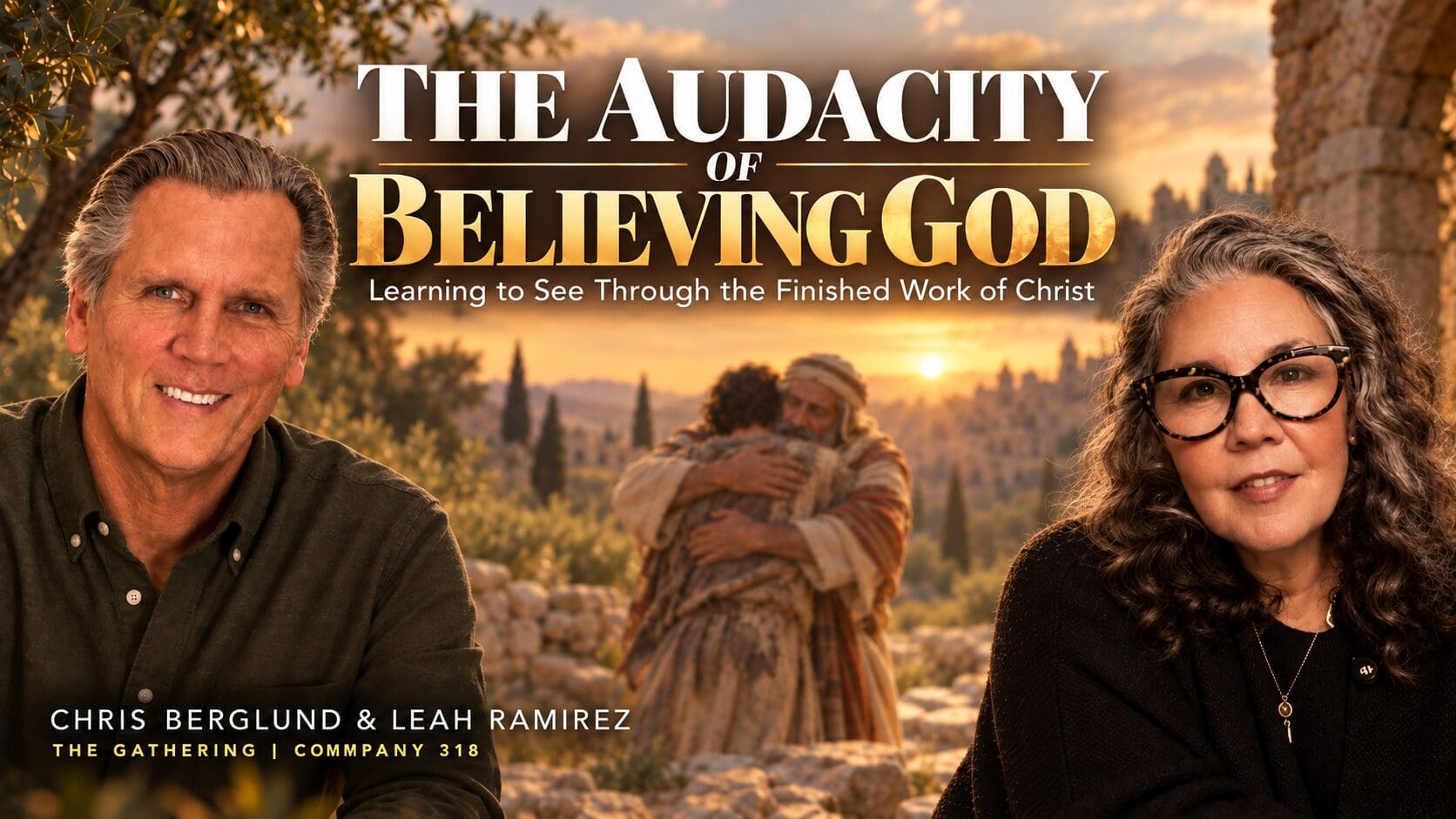
By Chris Berglund & Leah Ramirez | October 12, 2026
We have never co-preached a Sunday message before. We have spent countless hours exploring Scripture together, wrestling through theological questions, and writing about the Gospel, but sharing a single message from the pulpit was something new for us. And we have to admit, it was fun.
What surprised us was how beautifully the Lord Himself wove the pieces together. Chris had changed the direction of his message the night before, prompted by a fresh encounter with a story from Scripture that had stayed with him for more than twenty years. Leah had been preparing along an entirely different line of thought. Yet as we began sharing, connections emerged that neither of us had planned. We found ourselves discovering something together, even as we were teaching it.
David’s mighty men, the longing of the King, an unexpected encounter in Orlando, the prayers we carry for our children, and a testimony of divine healing all began to reveal something about the nature of faith that we believe the Church desperately needs to recover.
Faith does not make something true. Faith believes what God has already declared to be true.
That might sound obvious, but consider how much of our Christian lives can be spent trying to produce enough faith to make something happen. We read the extraordinary promises of Scripture concerning righteousness, healing, freedom from sin, and our new identity in Christ, and somewhere along the way, we become more occupied with whether we believe enough than with the One who has spoken.
Without realizing it, we can turn faith itself into another form of religious performance.
We begin examining our confidence, measuring our surrender, and searching ourselves for evidence that we have finally arrived at the kind of believing that will move God to act. Beneath all that spiritual effort is a subtle misunderstanding of the Gospel. We have begun to treat faith as though it accomplishes something that only Jesus could accomplish.
But what if we have been approaching faith from the wrong starting point? What if the Christian life is not primarily about developing a greater capacity to believe, but about beholding Christ until our hearts become persuaded of what is already true in Him?
What if the breakthrough we have been working so hard to produce begins with seeing something of God’s nature and character that finally frees us to agree with Him?
This is the audacity of believing God. Not confidence in the strength of our faith, but confidence in the faithfulness of the One who has spoken.
The Broken Ones Who Became Mighty
In 1 Samuel 22, David has already been anointed king, but the circumstances of his life seem to contradict what God has spoken. Saul is pursuing him, and David has taken refuge in the cave of Adullam. He is the anointed king, though he has not yet taken the throne.
And then an unlikely company gathers around him.
“Everyone who was in distress, and everyone who was in debt, and everyone who was bitter in soul, gathered to him” (1 Samuel 22:2, ESV).
Four hundred men came to David. They were not Israel’s finest soldiers. They were distressed, indebted, and discontented. They were people who had very little to offer, gathered around a king who was himself living under the shadow of an unfulfilled promise.
Yet from this company came the mighty men of David.
Consider what this reveals about the Gospel. These men did not become mighty in order to qualify for the presence of the anointed king. They gathered around him in their distress, and their lives began to take on the character of the one they followed.
The transformation did not begin with their strength. It began with their nearness to the king.
How much more is this true for those who have been joined to Christ?
Under the Old Covenant, the Spirit of God came upon men and women for extraordinary works. But Paul declares something even more astonishing concerning the believer: “He who is joined to the Lord becomes one spirit with him” (1 Corinthians 6:17, ESV).
We have not merely gathered around an anointed king. We have been joined to Him. His death has become our death. His resurrection has become our entrance into newness of life. His righteousness is the ground upon which we now stand.
And yet how easily we continue to evaluate our lives according to the distressed and indebted people we once were, rather than the King to whom we have been joined.
We speak about ourselves as though Adam still has the final word over our identity. We measure our standing by yesterday’s failures, our spiritual progress by our ability to perform, and our future by the limitations we have become accustomed to living under.
Meanwhile, Paul is inviting us to reckon ourselves dead to sin and alive to God in Christ Jesus (Romans 6:11).
He is not asking us to imagine something that is untrue until we can somehow make it real. He is calling us to agree with what has happened through the death and resurrection of Jesus.
The mighty men of David give us a beautiful picture of this agreement.
In 2 Samuel 23, Josheb-basshebeth stands against overwhelming odds. Eleazar fights until his hand clings to his sword. Shammah stands in the middle of a field of lentils when others have fled, refusing to surrender the ground to the Philistines.
There is something compelling about Shammah standing in that field. To everyone else, it may have seemed an insignificant thing to defend, but he refused to yield it to the enemy.
We too have an inheritance worth standing in. Not because we are determined to prove ourselves strong, but because the Gospel has declared something about us that our circumstances do not have the authority to overturn.
Our righteousness in Christ is not a fragile possession that disappears whenever we stumble. Our union with Him is not a spiritual achievement that must be recreated each morning. The new creation is not a distant possibility awaiting our sufficient maturity.
These things have been established in Jesus.
There is certainly a training in righteousness, a maturing in our ability to recognize what is true and live from it. Hebrews 5 speaks of becoming skilled in the word of righteousness. But we must understand the order. We are not training to become righteous through our proficiency. We are learning to live from the righteousness we have received in Christ.
We are becoming skilled in agreeing with God.
Close Enough to Hear the Longing of the King
There is another story among David’s mighty men that reveals something even more beautiful about the life to which we have been invited.
In 2 Samuel 23:13–17, three of David’s men overhear him longing for water from the well of Bethlehem. David has not summoned them or commanded them to retrieve it. He has simply expressed a desire, and these men are close enough to hear what is on his heart.
Out of their affection for David, they break through the Philistine garrison and bring water from the well to their king.
It is a remarkable picture of love.
They are not responding to an obligation imposed upon them. They are responding to a longing they have overheard. Something precious to David has become precious to them because of their relationship with him.
Chris shared that he had dreamed about this story several times over the years, and that he had always wanted to be one of those three unnamed men. There was something about their friendship with David that captured his heart. They were close enough to overhear the longing of the king, and they loved him enough to respond without being commanded.
Jesus describes something of this friendship in John 15:15 when He tells His disciples that He no longer calls them servants, but friends, because He has made known to them what He has heard from His Father.
This is the intimacy of the Gospel. We are invited near enough to know His heart, to recognize His desires, and to participate in what He is doing.
And perhaps this changes the way we understand prayer, intercession, and even the burdens we carry for other people.
What if some of the deepest longings of our hearts have actually begun in His?
The Door We Didn’t Expect
As Chris was sharing about David’s mighty men, Leah began remembering an experience from nearly twenty years ago. It was a story she had told many times, but something about hearing the longing of David’s heart was causing her to see it differently.
At the time, Leah was leading a small community of young people in Orlando. They had very little money, no building of their own, and none of the resources anyone would consider necessary for influencing a region. They were young, inexperienced, and in many ways entirely unqualified for the things they began to sense the Lord speaking to them about.
And God began speaking to them about stadiums.
Even now, that word requires some explanation because of how easily it can be misunderstood. This was not a group of young people dreaming about becoming famous preachers or imagining themselves standing before enormous crowds. They were beginning to overhear something of God’s longing for a region.
They believed there were people on His heart whom they had not yet met.
For several years, they walked around stadiums, prayed for cities, and asked the Lord how He intended to reach people beyond the walls of the Church. They were turned away from public parks and denied access to buildings. They had no clear strategy and very few open doors. But they continued carrying this longing before the Lord.
One evening, a young woman named Jada shared a dream. In the dream, the entrance to the stadium was through the Parliament House, a well-known gay and lesbian resort in Orlando.
They did not know what to make of it.
What they understood was that God was drawing their attention to people they had not previously considered part of the story. They began praying for the community surrounding the Parliament House, recognizing that the Lord’s heart was not limited to those who were already comfortable within the walls of a church.
Some time later, another young woman named Tammy became convinced that she and Leah were supposed to physically walk into the Parliament House.
And immediately, fear rose up in Leah.
What would they encounter? How would they be received? What would people think of them being there? She had encouraged these young people to respond to what they believed God was speaking, but now she found herself confronted with the implications of her own teaching.
Eventually, they went.
When they walked through the doors, a young man approached them and offered to show them around. For nearly two hours, he took them through the property, introducing them to different spaces and welcoming them into a community they had previously known mostly from a distance.
Leah remembers being surprised by how warmly they were received.
She also remembers something being exposed in her own heart. There was a fear she had carried into that place, an expectation of what she might encounter and how she might need to protect herself from it. Yet the people she met were welcoming and gracious, and she began to recognize how much of her apprehension had been shaped by assumptions rather than love.
How often do we expect people to enter our churches, where they may feel uncomfortable or uncertain of their welcome, while hesitating to enter the places where they have found community?
How often have we allowed fear of being contaminated by what we consider darkness to keep us from drawing near to the very people Jesus loves?
When Jesus touched the leper, He was not contaminated by the man’s condition. The cleanness of Jesus was not threatened by what He encountered. His life was the greater reality.
And perhaps this is one of the most important things the Gospel must restore in us. We have sometimes imagined holiness as something so fragile that it must be protected from proximity to brokenness. But in Jesus, we encounter a holiness that moves toward humanity, a righteousness that is not intimidated by sin, and a love that enters the places where people are living rather than waiting for them to find their way out.
When Leah and Tammy returned to the car that afternoon, they held hands and prayed. They did not fully understand what had happened, but they knew they had said yes to an open door.
Looking back, Leah can see that the Lord was doing more than giving them a strategy for reaching a region. He was confronting a way of seeing people that had never truly reflected His nature.
God was allowing them to overhear His longing for His children.
And that longing was beginning to change how they saw the world.
God Is Already in Their Story
This brings us to something many of us are carrying right now.
There are parents who have prayed for their children for years, watching them make decisions they never imagined they would make. There are families carrying the pain of estrangement, disappointment, addiction, and relationships that seem impossible to restore. There are sons and daughters of the heart, people we have loved and walked with, whose stories have taken turns that leave us wondering what to do next.
Sometimes the pain of these situations is compounded by the way we interpret them.
A parent begins to see a child’s struggle as evidence of personal failure. A loved one’s anger toward God becomes proof that they are moving farther and farther away from Him. We rehearse everything that appears to be wrong, and our prayers can become filled with the language of distance and separation.
We begin speaking as though God is outside the story, waiting for us to persuade Him to intervene.
But what if we have been looking at the story through the wrong lens?
God is already in their story.
Before we ever carried that son or daughter in prayer, the Father knew them. Before we recognized the burden, His heart was already turned toward them. The longing we feel is not evidence that we care more deeply than God does. It may be an invitation to participate in His own love for them.
This does not mean we deny the reality of a person’s decisions or pretend there are no consequences to the things they are walking through. Love does not require us to abandon wisdom or ignore what is destructive. But neither does wisdom require us to let someone’s present condition define the whole of who they are.
Their story is still playing out.
And there is something profoundly liberating about realizing that we are not responsible for bringing God into their story. He is already there. Our invitation is to recognize His presence, agree with His heart, and participate in His love.
Consider how this changes our prayers.
Instead of trying to drag a reluctant God into someone’s life, we begin asking Him to open our eyes to where He is already moving. Instead of carrying the crushing responsibility of producing an outcome, we learn to carry people in the love of the Father.
One posture leaves us exhausted, constantly evaluating whether we have prayed enough, believed enough, or done enough to bring someone home.
The other teaches us to remain with people in hope, trusting that the Father’s faithfulness is greater than our capacity to control the story.
Jesus looked upon the crowds and declared that the harvest was plentiful. He did not instruct His disciples to convince the Father to desire a harvest. He told them to pray for laborers (Matthew 9:37–38).
The longing was already in the heart of God.
We are being invited to share it.
Perhaps some of the people we have been carrying in prayer are themselves doors to an entire generation. Perhaps our sons and daughters, our friends, and the children of our hearts are connected to people we may never otherwise meet.
We do not need to look beyond the people already entrusted to our hearts to find the harvest. We can begin by agreeing with the Father’s love for them.
And we can stop interpreting their unfinished stories as evidence that God has somehow failed to appear.
When Faith Becomes Another Form of Performance
There is a related misunderstanding that deserves our attention because it can affect nearly every part of the Christian life.
We can believe in the finished work of Jesus and still live as though the results depend upon our ability to generate sufficient faith.
We can spend years learning how to believe for healing, how to pray with authority, how to overcome fear, or how to obtain breakthrough. None of these pursuits is inherently wrong. But somewhere along the way, the focus can quietly shift from the nature of God to the condition of our own believing.
We begin looking at our faith more than we are looking at Jesus.
Leah shared a testimony from more than twenty years ago, when she was preparing to teach a class on divine healing. She had been reading T. L. Osborn’s Healing the Sick, gathering material to help her students understand what Scripture revealed about healing.
Leah had struggled with asthma since childhood, including repeated hospitalizations, and had simply accepted it as a condition she would manage throughout her life. It had never occurred to her that the Scriptures she was studying might have something to say about her own condition.
But as she continued reading, something unexpected happened.
The book continually directed her attention to passages revealing God as healer. Rather than simply presenting a methodology for producing healing, it was inviting her to behold the One who heals.
And as she read, she began to sense the Lord asking her a question: Why had she never looked to Him as her healer?
At first, the question surprised her. She was preparing to teach others about healing, but had not considered bringing her own condition before Him with that expectation.
Then something began to change.
Leah was not examining herself to determine whether she possessed sufficient faith. She was not attempting to work up confidence or manufacture certainty. She was looking at the Healer, and as she saw Him, she found herself becoming persuaded.
She knew He was her healer.
And when that settled in her heart, she stood in her room, lifted her hands, and began to thank Him.
The next morning, as she was preparing to leave for rowing practice, she reached for her keys and saw the inhaler she had always carried with her. She had never gone out on the water without it because of the severity of her asthma. In that moment, she faced a deeply personal decision about how she would respond to what she believed the Lord had revealed.
She chose to leave the inhaler behind.
More than twenty years have passed, and she has not had another asthma attack.
That is Leah’s personal testimony, not a prescription for others to discontinue medication or necessary medical care. But the most significant part of the encounter was not a method she discovered or a particular action she took. It was the way God revealed Himself to her.
For years, she might have told that story primarily as an example of standing in faith. And certainly there was a moment when she chose to act according to what she believed the Lord had shown her.
But recently, she has begun to see the testimony through a deeper lens.
The breakthrough did not begin when she finally managed to generate enough faith. Faith had awakened because she had beheld something true about God.
She was not persuaded by the strength of her believing. She had become persuaded by the goodness and faithfulness of the One she was beholding.
We believe this distinction matters enormously because otherwise we can turn intimacy into performance. We can make surrender into an achievement, and faith into one more thing we must successfully produce before we are permitted to receive from God.
There is a subtle way that self-examination can disguise itself as spiritual maturity. We believe we are taking faith seriously, but our attention has shifted almost entirely toward ourselves. We are assessing whether we have surrendered enough, trusted enough, believed enough, or reached some internal condition that will finally allow God to move.
And the entire time, Jesus is inviting us to look at Him.
What if faith was never meant to become another object of our scrutiny?
What if the invitation is to behold the One who is faithful until our hearts become persuaded by what we see?
This does not make faith passive. The men who stood with David acted. Shammah defended his field. Eleazar held his sword. The three mighty men broke through enemy lines to bring water to their king.
But their actions flowed from something deeper than a determination to prove themselves. Their lives had been formed through nearness to the king, and their responses emerged from what they had come to know of him.
The same is true of us.
Faith responds. Faith agrees. Faith acts upon what has been revealed. But faith does not create the truth to which it responds.
Revelation comes first. The Spirit opens our eyes to Christ. We behold Him, recognize what is true, and our hearts begin to agree.
This is the order of the Gospel.
Refusing to Regard Anyone According to the Flesh
Paul’s words in 2 Corinthians 5 give us a foundation for everything we have been considering.
“From now on, therefore, we regard no one according to the flesh” (2 Corinthians 5:16, ESV).
What a remarkable declaration.
Paul is describing a fundamental change in the way we see humanity because of what God has accomplished in Jesus Christ. The death and resurrection of Christ have established a new reality, and Paul refuses to continue evaluating people according to the old one.
He goes on to declare that anyone in Christ is a new creation. The old has passed away; the new has come. And then he tells us that all of this is from God, who through Christ reconciled us to Himself and gave us the ministry of reconciliation.
“God was in Christ reconciling the world to himself, not counting their trespasses against them” (2 Corinthians 5:19, ESV).
We need to allow the magnitude of that statement to confront some of the assumptions we have inherited about God.
God was in Christ.
The Father was not standing at a distance, waiting for the Son to persuade Him to become merciful. The initiative of reconciliation came from God Himself. The cross reveals the love that was already in His heart.
And we have been entrusted with the message of what He has accomplished.
This is not a declaration that every person has already responded to the Gospel or entered into the fullness of salvation. Paul immediately appeals to his hearers: “Be reconciled to God” (2 Corinthians 5:20, ESV).
But notice where the appeal begins. It begins with God’s accomplished work in Christ, not with our attempt to make Him favorable toward humanity.
We are ambassadors of reconciliation. We do not create reconciliation through the intensity of our appeal. We announce what God has done in Jesus and invite people to respond.
And perhaps this is where we must allow the Gospel to confront the way we have learned to pray for people.
If we are not careful, we can carry a message of reconciliation while continuing to regard people according to the flesh. We speak about their failures, their addictions, their anger, their unbelief, and their distance from God as though those things are the most defining realities of their existence.
But Paul says that because of Christ, we no longer regard anyone that way.
We are not denying what is unresolved. We are refusing to allow what is unresolved to become the deepest truth we believe about someone.
Recently, Chris had a dream in which he heard words concerning the blood of Jesus over the Mason-Dixon line. Historically, that line became associated with the division between slavery and freedom in America. As we considered the dream, we began to see a picture of the blood of Jesus speaking a greater word over places of separation.
Chris understood the dream in two ways. The natural bloodline reminded him of family relationships that remain real even when fellowship has been fractured. And the blood of Jesus spoke of reconciliation and freedom where division had seemed to establish a permanent boundary.
Ephesians 2:13–14 tells us that those who were once far off have been brought near by the blood of Christ, and that He Himself is our peace.
There are dividing lines in families that have begun to feel permanent. There are histories of hurt and misunderstanding that seem to carry more authority than the promises of God. But we are invited to behold Jesus, who has made peace through His blood, and to allow that truth to shape how we pray and how we love.
We do not know what every restoration will look like or how long every process will take. We do know the nature of the Father revealed in Jesus.
He is the Father who runs toward His children.
And if we have been joined to Him, that same love must begin to shape our relationships. We cannot become people who casually discard sons and daughters, mothers and fathers, or brothers and sisters simply because their journeys have become difficult.
There will be times when wisdom requires boundaries, when trust must be rebuilt, and when love must be expressed in ways we would not have chosen. But we can remain rooted in the heart of a Father who does not throw people away.
This is part of the apostolic architecture we believe God is establishing in His Church. Not merely ministries with greater influence or structures with greater reach, but a people who have been formed in the nature of Christ. Fathers and mothers who know how to remain with people through the long and sometimes painful processes of transformation. A covenant people whose love is not dependent upon another person’s ability to make the right decisions at every turn.
The ministry of reconciliation is not merely a message we preach. It is a life we are being formed to embody.
What We Have Beheld Has Made Us Believers
Reinhard Bonnke used to say, “What I’ve seen has made me an incurable believer.”
It would be easy to hear those words and imagine that he was referring to the immense crowds, the miracles, and the extraordinary testimonies of his evangelistic ministry.
But perhaps there is something far more profound in that statement.
What if what he had seen most clearly was Jesus?
What if he had become so persuaded by the Gospel, so convinced of the nature and character of God, and so established in the accomplished work of Christ that unbelief had lost its ability to govern his life?
We have spent so much time in the Church teaching people how to have faith, how to increase their faith, how to exercise their faith, and how to identify what may be hindering their faith. But perhaps we have not spent nearly enough time helping people behold the One who is faithful.
We do not need another spiritual burden added to the weight many are already carrying.
We need to see Jesus.
We need to see the One who entered humanity rather than abandoning it, who came near to sinners without fear, who touched the unclean and made them whole, and who gave Himself to reconcile us to the Father.
We need to see the risen Christ in whom we have been made alive, the righteous One in whom we now stand, and the faithful High Priest who continues to reveal the Father’s heart.
We need to see Him in the stories of our children, in the places of estrangement, and in the circumstances where fear has been speaking more loudly than His promises.
And as we behold Him, something begins to happen within us. The things that once seemed impossible to believe become increasingly difficult to deny. We begin to recognize that His faithfulness is not dependent upon our emotional certainty. His love is not waiting for our performance. His reconciliation was not initiated by our desire for Him, but by His love for us.
We begin to live from what He has accomplished.
This does not mean every circumstance immediately changes or that faith somehow exempts us from the unfinished processes of life. It means we are learning to interpret those circumstances through a greater revelation.
Shammah stood in his field because he knew what he was defending. The three mighty men brought water to David because they knew the heart of their king. And we are invited to stand in the inheritance of Christ and carry the longings of His heart because we have been brought near enough to know Him.
We can stand with our children without surrendering to despair. We can remain with people whose stories have not yet resolved. We can pray for the sick without making the strength of our faith the center of the encounter. We can carry the message of reconciliation without allowing another person’s present condition to become our final assessment of them.
We can become believing believers.
Not because we have mastered some spiritual technique, but because we have come to know the One who is faithful.
Perhaps the audacity of believing God is simply the willingness to let His revelation become more authoritative in us than the fears, disappointments, and assumptions that have shaped our lives.
And perhaps the most beautiful evidence of that faith will be found not only in the extraordinary things we see, but in the way we love. In our willingness to remain, to believe, to forgive, and to carry one another with the steadfast affection of the Father.
There is a generation on His heart. There are sons and daughters He longs to gather. There are people we have not yet met whose lives are already precious to Him.
May we draw near enough to overhear His longing, and may what we have beheld in Jesus make us incurable believers.
Watch the Full Message
The Audacity of Believing God | Chris Berglund & Leah Ramirez
Watch the full teaching on YouTube
Join Us at The Gathering
If you have been carrying the weight of trying to believe enough, perform enough, or somehow become acceptable to God, we would love to welcome you into a community learning to live from the finished work of Jesus.
At The Gathering in Colorado Springs, we open the Scriptures, behold Christ, pray together, and learn to live from the life we have received in Him. There is room to ask questions, grow, and belong.
Sundays at 10:00 a.m.
720 Elkton Drive, Colorado Springs, CO 80907
Go Deeper and Partner With Us
Behold School — Explore a formation journey rooted in the Gospel, union with Christ, and learning to abide in the life we have received.
Company 318 — Connect with our wider community of believers growing together through Scripture, prayer, and shared life.
Give and Partner With Us — Your generosity supports The Gathering, Company 318, and Behold School as we continue making Christ-centered teaching, prayer, and spiritual formation available to others.
The Audacity of Believing God
Leave a Reply Cancel reply

THE GATHERING
A local church and teaching community in Colorado Springs.
Sundays at 10:00 a.m.
720 Elkton Dr.
Colorado Springs, CO 80907
EXPLORE
LIFE TOGETHER
WIDER COMMUNITY
SUPPORT & CONTACT
About The Gathering
Leah Ramirez
Chris Berglund
Teaching
Reflections / Blog
Devotionals
Small Groups
Beholding and Prayer
The Grove
Planted Youth
Company 318
Behold School
Latest Teaching
YouTube
Facebook
Give
Contact Us
info@the-gathering.us
407-340-0204
@ 2026 The Gathering
What We Believe
Waic Up Call - Y.A.
The Vine - Kids