
October 5, 2026
There is a kind of righteousness that looks impressive from a distance. It knows the rules. It knows how to behave. It can tell you where the boundaries are and may even be very good at keeping them. Paul knew that kind of righteousness better than almost anyone.
He had been trained by Gamaliel. He called himself a Pharisee of Pharisees. According to the law, he could say he was blameless. He had zeal, discipline, knowledge, pedigree—all the things that should have made him the picture of a righteous man. And yet that same zeal left him standing nearby while Stephen was stoned.
Paul watched a man die praying for the people killing him: “Lord, do not hold this sin against them.” Paul was consenting to Stephen’s death while Stephen was asking God for mercy. That contrast tells us something about righteousness. One man was zealous enough to condemn. The other had become enough like Jesus to forgive while stones were still hitting his body.
Paul would spend the rest of his life learning the difference.
Righteousness Is the Root, Not the Reward
One of the great reversals of the Gospel is that God does not wait for us to become holy enough to make us righteous. He makes us righteous in Christ, and holiness grows from that righteousness.
We so easily reverse the order. We imagine that if we can overcome enough, obey enough, clean ourselves up enough, control ourselves enough, then perhaps one day we will finally become the kind of person God calls righteous. But Paul’s Gospel runs the other direction.
Christ “became to us wisdom from God, righteousness and sanctification and redemption” (1 Corinthians 1:30). In Romans 5, Paul calls righteousness a gift. In 2 Corinthians 5, he goes even further: in Christ, we become the righteousness of God.
This is not a garment God temporarily drapes over an unchanged person while pretending not to notice what is underneath. We have been joined to Christ. “The one who joins himself to the Lord is one spirit with Him” (1 Corinthians 6:17). Righteousness is not merely something Christ hands us. Christ Himself has become our righteousness.
That matters because what we believe about our standing before God determines how we approach Him when we fail. If righteousness is something I maintain through my performance, then the moment I stumble, I will pull away. I will hide. I will wait until I feel repentant enough, clean enough, sorry enough, spiritual enough to come back.
But if my righteousness is Christ, then failure does not become an invitation to hide from Him. It becomes the very place where I learn to run to Him. Not because sin does not matter. Not because there is no confession, repentance, or transformation. But because the One who transforms us is the very One shame tells us to avoid.
We do not mature by running from His presence. We mature by learning to live there.
Learning to Be Skilled in Righteousness
Hebrews 5 uses an interesting phrase. It describes the immature as those who are “not accustomed to the word of righteousness.” Other translations speak of being unskilled in righteousness. That opens up an important distinction: there is the gift of righteousness, and there is learning to live skillfully from the righteousness we have received.
Isaiah describes God’s people as “oaks of righteousness, the planting of the LORD” (Isaiah 61:3). God plants the tree. The tree does not plant itself. Its identity comes before its fruit. But eventually a righteous tree should begin bearing righteous fruit.
Mercy begins appearing because the Merciful One lives within us. Peace begins appearing because the Prince of Peace lives within us. Patience, kindness, forgiveness, compassion and love become more than virtues we are trying to imitate. They become the life of Christ finding expression through His people.
This is where the Gospel becomes beautifully practical.
Chris shared about the Lord dealing with him recently over his impatience and anger. His first instinct was to start looking for some hidden thing inside himself, some dark root that needed to be uncovered. But what he sensed from the Lord was different.
The issue was not that he needed to go digging around trying to discover another hidden identity beneath Christ. He needed to become more skilled in the righteousness already given to him. The patience of Christ was present. The life of Christ was present. But in that particular place, he had not yet learned to yield to and express that life.
That is such a different way to understand transformation. Instead of endlessly asking, “What is wrong with me?” we can begin asking, “Jesus, what does Your life look like here?” What does Your patience look like in me when I am irritated? What does Your mercy look like when someone disappoints me? What does Your love look like when I am dealing with someone I genuinely do not like? What does Your forgiveness look like when I have actually been wronged?
Formation is not the construction of a better independent self. It is Christ being formed in us.
Paul’s Righteousness Had Scars
This is where Paul’s story becomes so beautiful. The man who once stood among the religious elite eventually wrote, “Not having a righteousness of my own derived from the Law, but that which is through faith in Christ” (Philippians 3:9).
But he does not stop with righteousness. His next longing is “that I may know Him and the power of His resurrection and the fellowship of His sufferings.”
Paul’s righteousness did not remain theoretical. It walked through beatings, prisons, betrayal, hunger, shipwrecks, rejection and weakness. He was stoned. He was beaten. He was shipwrecked. And after surviving one of those shipwrecks, we find him on the shore gathering sticks to make a fire for everybody else.
That is righteousness with scars.
Not because suffering itself makes anyone righteous. Jesus has already become our righteousness. But life gives us countless places where the righteousness we have received can become the righteousness we actually express. Pressure reveals what we have learned to live from.
Paul began as a man whose zeal for God could participate in the death of another human being. Yet after years of knowing Christ, suffering with Christ and being formed by Christ, he could write, “The love of Christ controls us” (2 Corinthians 5:14).
Think about that transformation. He went from being zealous enough to kill to being compelled by love enough to lay down his own life. That is not behavior modification. That is Christ.
Mercy Is One of the Fruits
Perhaps one of the clearest evidences that righteousness is becoming mature in us is the way we begin to see other people. James tells us that “mercy triumphs over judgment,” and Jesus embodied this continually.
Again and again, the disciples seemed confused by the people He allowed near Him. Why would He allow that woman to come so close? Why eat with Zacchaeus? Why sit at a table with sinners? Why keep moving toward people whose lives were visibly broken?
Because Jesus saw more than what was presently manifesting in them.
As Chris said Sunday, “He didn’t give people what they deserved. He gave them what He paid for.”
That line is worth staying with. What if becoming skilled in righteousness means that we increasingly learn to see people through what Christ has done rather than simply through what they are doing right now?
That does not mean we never confront. It does not mean repentance is unnecessary or that destructive behavior should be ignored. Sometimes love corrects. Sometimes love confronts. Sometimes love establishes very clear boundaries. But righteousness is not a formula.
The question becomes: “Father, what are You doing with this person? What does Your heart look like toward them here? What response will actually serve restoration?”
Paul tells the mature in Galatians 6 to restore the one caught in sin in a spirit of gentleness. The mature restore.
That should challenge us in a culture that has become very skilled at exposure. When somebody falls, our age can turn their failure into content before anyone has even stopped to ask what restoration might look like. But if the fruit of righteousness is Christ, then maturity will increasingly carry His heart toward broken people.
Not sentimental mercy. Redemptive mercy. The kind that tells the truth while still believing resurrection is possible.
There Is Still Time
Maybe one of the most tender moments of Sunday’s message came when Chris talked about a neighbor he has struggled to love. He did not dress it up. The relationship has been difficult. When he learned that this man was sick, his first response was not compassion. And the Lord began putting His finger there.
Not with condemnation, but invitation.
Chris shared a dream from years ago in which he was sitting with the Lord, wondering whether he had really fulfilled everything he had been called to do. In the dream, the Lord told him, essentially, “No, you haven’t. But there is still time.” Then He kissed him on the cheek.
There is something of the Gospel in that. Not: You failed, so get away from Me. Not: Pretend it did not matter. But: This still does not look like Me. Come closer. There is still time.
That is how righteousness trains us.
We do not have to condemn ourselves to agree with God that an area of our lives has not yet come into the maturity of Christ. We can look honestly at impatience, unforgiveness, fear, anger, self-protection or the places where love has remained immature and say, “Jesus, I know this is not the fullness of Your life in me. Teach me.”
There is no shame in that prayer. There is tremendous hope in it.
Because the goal of the Gospel was never merely forgiven people waiting to go to heaven. God’s purpose is that we would be conformed to the image of His Son. Paul writes in Ephesians 4 about the Church growing “to a mature man, to the measure of the stature which belongs to the fullness of Christ.”
The fullness of Christ. That is where the Gospel is taking us.
Not through religious striving. Not through obsession with our failures. Not through trying to manufacture holiness so God will finally call us righteous. Through union. Through communion. Through beholding. Through believing what God has already said about us in Christ and allowing that truth to become the place from which we live.
The righteousness is already His gift. Now He is teaching us to walk in it.
And sometimes that righteousness will have scars—not scars that prove how spiritual we are, but scars that tell the story of a life that kept encountering Jesus in real places, under real pressure, among real people, and kept allowing His love to have the final word.
The man who once watched Stephen die eventually became a man willing to spend his own life for others. Zeal became love. Performance gave way to union. Righteousness became fruit.
And perhaps that is the invitation for all of us: not to become righteous through our effort, but to become increasingly skilled in the righteousness that is already ours, until the life others encounter in us looks more and more like Jesus.
Watch the full message:
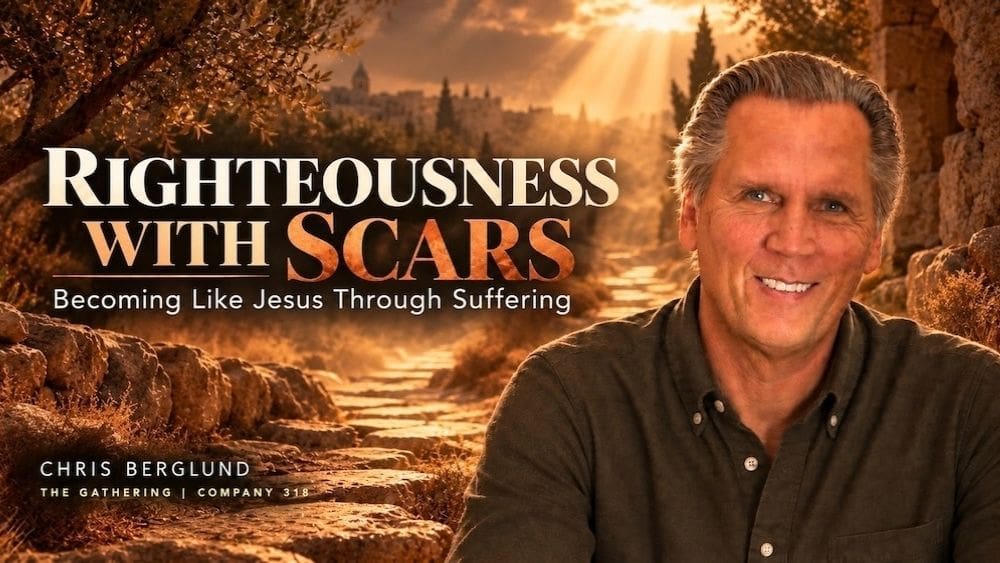
Righteousness With Scars | Becoming Like Jesus Through Suffering | Chris Berglund
CONNECT WITH THE GATHERING
Visit The Gathering
Partner With The Gathering
GO DEEPER
Company 318
Behold School
Righteousness With Scars | How the Life of Christ Is Formed in Us
Leave a Reply Cancel reply

THE GATHERING
A local church and teaching community in Colorado Springs.
Sundays at 10:00 a.m.
720 Elkton Dr.
Colorado Springs, CO 80907
EXPLORE
LIFE TOGETHER
WIDER COMMUNITY
SUPPORT & CONTACT
About The Gathering
Leah Ramirez
Chris Berglund
Teaching
Reflections / Blog
Devotionals
Small Groups
Beholding and Prayer
The Grove
Planted Youth
Company 318
Behold School
Latest Teaching
YouTube
Facebook
Give
Contact Us
info@the-gathering.us
407-340-0204
@ 2026 The Gathering
What We Believe
Waic Up Call - Y.A.
The Vine - Kids