
June 8, 2026
There are seasons when God begins to revisit old places in us, not to shame us or drag us backward, but to let us see the story differently. Sometimes He brings us back to moments we thought we had already processed because He wants to reveal where we absorbed the wrong conclusion. What felt like failure may not have been failure at all. What felt like rejection may not have been the final word. What felt like proof against the promise may actually be the very place where God wants to restore our sight.
After Juniah and Ricardo’s wedding, I found myself awake in the night, processing more than the exhaustion of the week. Something spiritual had shifted. A daughter had left and cleaved. A family structure had changed. A season had turned. And in that turning, the Lord began speaking to me about places in my own life where I had internalized disappointment as evidence that maybe I had missed it, maybe the calling was not real, or maybe the lack of partnership, response, or visible fruit meant something was lacking in me.
There are moments when we step out in faith, receive pushback, and then begin to replay the pain as proof against the promise. We look at what did not happen, who did not show up, who did not partner, and who did not understand, and somewhere deep inside we begin to wonder if the call itself was the problem. But I believe God is inviting us to revisit those places through His lens, not through accusation, disappointment, striving, or the need to prove we were right all along, but through the lens of life.
This week I found myself back in Genesis, sitting again with the garden. Genesis tells us that the Lord God caused every tree to spring up from the ground, trees that were pleasant to the sight and good for food. Then it says that the tree of life was in the midst of the garden, and the tree of the knowledge of good and evil.
Most of us have always read that as two trees: the tree of life in one place and the tree of the knowledge of good and evil somewhere else. That may be right. But I came across a rabbi presenting another possibility. He wondered if perhaps the text is inviting us to see one tree in the middle of the garden, a tree that could be approached in two different ways.
I am not saying I have fully landed there. I am still sitting with it. But the question has been messing with me in the best way, because Genesis 3 says the serpent tempted Eve concerning the tree in the middle of the garden. And the tree we were first told was in the middle was the tree of life.
So what if the deepest question is not only, “Which tree did they eat from?” What if the question is also, “How did they approach the tree?” Because there is a way to reach for holy things that does not lead to life. There is a way to reach for revelation, wisdom, authority, calling, and even likeness to God that is not rooted in faith, but in suspicion.
The serpent’s lie was not simply, “Eat this fruit.” The deeper lie was, “God is withholding something from you.” It was the suggestion that humanity was not yet what God had already said they were. It was the accusation that they would have to take for themselves what God had not freely given. It was the temptation to grasp at likeness, even though they had already been made in His image.
And I wonder how often that same temptation still plays out in us. We reach for significance because we do not believe we are already beloved. We reach for calling because we do not trust that we are already chosen. We reach for authority because we do not know how to rest as sons and daughters. We reach for ministry because we are still trying to prove we belong. What was meant to be the tree of “I Am” becomes, in our hands, the tree of “I am not.”
There is something about grasping that always distorts the gift. Life cannot be seized. Love cannot be stolen. Union cannot be forced. It can only be given and received. This is true in our life with God, and it is true in ministry, family, leadership, prayer, preaching, parenting, building, and love.
There is a way to touch holy things that leads to death, not because the thing itself is death, but because our approach is rooted in fear, suspicion, striving, or performance. We can grasp at reputation, spiritual authority, visible fruit, outcomes, partnership, and being seen as faithful or sacrificial. But I keep sensing the Lord bringing me back to something very simple: “Just express what I am doing in you. That is enough.”
That word confronts so much of what we have often called ministry. We can create environments where people are pressured into responses their hearts have not yet awakened to give. We can stir emotion, increase urgency, create momentum, and get people to sign on the dotted line. But covenant is not the same thing as compliance. God is not after a contract signed under pressure. He is after awakened love.
Three times in Song of Solomon, we hear the warning not to awaken love before it desires. There is a holy timing to love. There is a pace to covenant. There is a way the heart opens that cannot be manufactured. This matters because salvation is not merely a transaction. It is union. It is the receiving of His “yes” over us and the awakening of our “yes” in response.
Philippians 2 says that Jesus, though He was in the form of God, did not count equality with God a thing to be grasped. That word has been burning in me. Jesus is the One who had every right to seize, claim, demand, and hold, and yet He shows us the way of life by refusing to grasp. He emptied Himself, took the form of a servant, was born in the likeness of men, humbled Himself, and became obedient to the point of death, even death on a cross.
Jesus does not only bring us to the tree. He becomes the tree. He becomes the Life in the middle of the garden, the One who teaches humanity how to approach Life again. He shows us that the way back is not through grasping, suspicion, or striving to become what we already are in Him. The way back is through receiving.
The Father is not withholding life from us. The Father has given us His Son. The cross is the full display of His vow. Before we ever responded rightly, He gave Himself fully. Before the bride said yes, the Bridegroom went first. He left His Father’s house, took on our flesh, entered our death, and raised us with Him into life.
This is the gospel hidden in the beginning. When Adam sees Eve and says, “bone of my bone and flesh of my flesh,” he is recognizing the one who is distinct from him but not foreign to him. She is other, but she belongs. She came from him and is brought to him. But in Christ, we hear something even deeper. We hear the Bridegroom claiming His bride and saying, “You are not foreign to Me. You are not far off. You are not merely a servant. You are friend, beloved, and bride. You are bone of My bone, flesh of My flesh, and spirit of My Spirit.”
Then Genesis says, “Therefore a man shall leave his father and his mother and hold fast to his wife, and they shall become one flesh.” Adam and Eve did not have a father and mother to leave. But Jesus did. The Son left His Father’s house and came for us. He held fast to His bride. He joined Himself to our humanity. He took on flesh, not temporarily, but forever.
The ascended Christ is not a ghost. He is not a vague spiritual concept. He is the resurrected Man, still bearing the wounds of love, seated at the right hand of the Father. The gospel is not God escaping humanity. The gospel is God redeeming it.
Paul says in 2 Corinthians that we are the aroma of Christ to God among those who are being saved and among those who are perishing. It is one aroma, but to one it is a fragrance from death to death, and to another it is a fragrance from life to life. Then Paul asks, “Who is sufficient for these things?”
That question brings me comfort, because if you are a feeler, you know what it is to walk into a room and feel resistance before a word is spoken. You know what it is to internalize the atmosphere and wonder what you did wrong or how you can fix it. Sometimes we do need to examine our hearts. Sometimes we need to repent. Sometimes our tone, assumptions, wounds, or reactions really are affecting the room. But sometimes the Lord is saying, “You do not get to control how My life in you is received.”
There is liberty in that. We can keep our hearts before Him, stay unoffended, remain tender, and let Him search us without making ourselves responsible for every response. We can spend years trying to adjust the strategy, perfect the delivery, soften the message, change the packaging, and control the outcome. But sometimes the assignment is much simpler and much harder than that. We are called to display the Son.
So perhaps the question before us is not simply whether we are eating from the right tree. Perhaps the question is whether we are approaching Life in the right way. Are we coming to God to take, or are we coming to receive? Are we grasping for identity, or are we resting in what He has already spoken? Are we trying to force fruit, or are we trusting the root system of union to produce what only life can produce?
I have never seen an apple tree straining to bear apples. It simply abides in the life of its roots. And this is the invitation before us. We are invited to come to the tree in the middle of the garden again, but this time not in suspicion, grasping, or fear that God is withholding something from us. This time, we come in recognition.
We recognize that we are already His. We recognize that He created us, formed us, redeemed us, and destined us to be His treasured possession. We recognize that we are not merely children and not merely servants, but a bride of full partnership.
So we receive His vow again. We hear Him say, “I have loved you with an everlasting love. I have drawn you to Myself in kindness. I do not take you because you have made yourself worthy. I take you because you are Mine. I have entered your death. I have raised you with Me into life. Where I am, you will be also. My Father is your Father. My life is your life. My Spirit is within you. I am yours and you are Mine.”
And our response is simple. It is yes. Not the yes of striving, performance, or trying to prove we deserve the invitation, but the yes of a bride who has heard the Bridegroom’s vow and believes Him.
Yes, Jesus. Where You go, we go. Where You stay, we stay. What You say, we say. We choose Your broken body as our bread. We choose Your poured-out blood as our wine. We choose this life with You over and over again.
We come to the tree in the middle of the garden, and this time, we do not grasp. We receive.
Watch the full message here:
If this message resonates with you, we would love to stay connected. You can learn more about The Gathering, our church family in Colorado Springs, here:
https://the-gathering.us/
If you would like to support the work of The Gathering and help us continue building a house of prayer, worship, teaching, and community, you can give here:
https://the-gathering.us/give
You can also follow along with our broader writings, teachings, and conversations through Company 318 on Substack here:
https://company318.substack.com/
Reflection Questions
- Where have I been grasping for something God has already given me in Christ?
- What would it look like for me to approach Jesus this week through recognition and receiving instead of striving, suspicion, or performance?
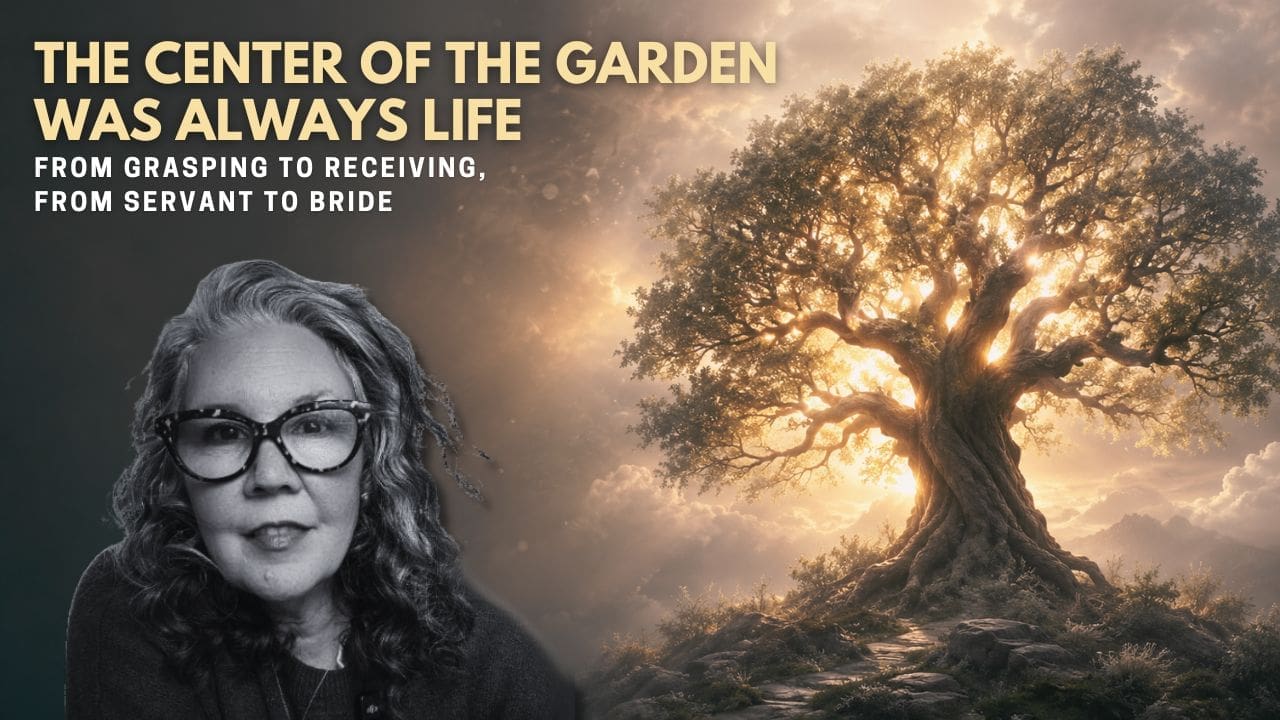
The Center of the Garden Was Always Life
Leave a Reply Cancel reply

THE GATHERING
A local church and teaching community in Colorado Springs.
Sundays at 10:00 a.m.
720 Elkton Dr.
Colorado Springs, CO 80907
EXPLORE
LIFE TOGETHER
WIDER COMMUNITY
SUPPORT & CONTACT
About The Gathering
Leah Ramirez
Chris Berglund
Teaching
Reflections / Blog
Devotionals
Small Groups
Beholding and Prayer
The Grove
Planted Youth
Company 318
Behold School
Latest Teaching
YouTube
Facebook
Give
Contact Us
info@the-gathering.us
407-340-0204
@ 2026 The Gathering
What We Believe
Waic Up Call - Y.A.
The Vine - Kids