
August 3, 2026
A Hebrews Overview
What was in the Father’s heart before the foundation of the world?
The gospel is often presented as God’s answer to humanity’s sin: Jesus came to forgive us, rescue us from judgment, and take us to heaven when we die. All of that matters, but it does not begin far enough back. Before sin entered the human story, the Father already had an eternal purpose. He desired to bring humanity into the life, fellowship, and glory of His Son.
Paul writes in Ephesians 1 that God chose us in Christ before the foundation of the world. Second Timothy 1 says that His purpose and grace were given to us in Christ before time began. The Father’s original intention was not merely to create servants who would obey Him from a distance. He desired many sons within His one beloved Son, enjoying the Son’s relationship with the Father and expressing the Son’s life throughout creation.
The Father did not merely want forgiven servants. He wanted sons in the Son.
The cross is central to this purpose, but the cross was not the final destination of God’s plan. Through the death and resurrection of Jesus, everything that prevented humanity from participating in the Son’s life was dealt with. The old humanity in Adam was brought into Christ’s death, and a new humanity was raised in Him.
The cross opened the way for the Father’s original intention to be fulfilled.
Salvation Restores Us to the Father’s Original Purpose
Romans 6 tells us that those who have been baptized into Christ have been baptized into His death and raised with Him into newness of life. Jesus did not come merely to improve the life we inherited in Adam. He came to bring that old order to an end and become the source of an entirely new life.
Salvation is therefore much greater than the forgiveness of individual sins. It is an invitation to participate in the life of Jesus Christ. We have been brought out of Adam and placed in the Son. We have been joined to Christ so that His life may become the source from which we live.
This is why Paul continually uses phrases such as “in Christ,” “in Him,” and “in the Beloved.” The Father’s purpose is located in His Son. We do not merely receive benefits from Jesus while remaining separate from Him. We are brought into union with Him.
The Father has invited us into the Son’s own fellowship with Him. We are not watching that relationship from the outside. Through Christ, we have been brought near and welcomed into the love, delight, and communion shared between the Father and the Son.
Hebrews 2 describes the Father’s purpose as bringing “many sons to glory.” Glory is not merely a heavenly atmosphere or a future destination. It is the nature and life of Christ becoming visible in a people. The Father is forming sons who live from the Son and increasingly express His character within the earth.
Beholding Christ and Becoming What We See
Second Corinthians 3:18 says that as we behold the glory of the Lord as in a mirror, we are transformed into the same image from glory to glory.
The image of a mirror is important because a mirror reveals what is already present. When we behold Christ, we are not looking at a distant example and attempting to copy Him through religious effort. We are beholding the One who lives within us and to whom we have been joined.
Chris explained that the glory of God is His nature. When Moses asked to see God’s glory, the Lord revealed His goodness, mercy, graciousness, patience, and truth. To behold the glory of Christ is to behold who He is. As we see His nature, we begin to recognize that this life is now present within us through our union with Him.
We are not transformed by remaining preoccupied with everything that is wrong with us. We are transformed by seeing Christ, agreeing with the life He has given us, and allowing His nature to displace the false identities and old patterns that once governed us.
His acceptance answers our shame. His mercy confronts our condemnation. His humility exposes our pride. His patience meets our frustration. His love frees us from competition, comparison, and offense.
Beholding does not mean pretending that the flesh does not exist. It means refusing to define ourselves by the flesh. We bring every old pattern into the light of Christ’s life and surrender it to the truth of who we have become in Him.
Do Christians Still Have a Sin Nature?
One of the most significant implications of union with Christ is that believers are no longer defined by the nature they inherited in Adam.
Romans 6 does not merely instruct us to stop performing sinful behaviors. It announces that our former master has been dealt with. We died with Christ, were buried with Him, and were raised into His life. The old nature does not need to be rehabilitated. It has been brought to an end in the death of Jesus.
Christians still experience temptation and contend with patterns that Scripture calls the flesh. The flesh includes the learned habits, desires, reactions, and ways of thinking that developed under the old order. These patterns must be renewed and brought into agreement with Christ, but they are not our truest identity.
The believer is not carrying two equal natures that are fighting for ownership. The old humanity in Adam was crucified with Christ. Our true life is now hidden with God in Christ.
Chris described how studying Romans 5 through 8 reshaped his understanding of the gospel. He began to see that sin in Romans 6 is frequently presented as a ruling power or former master rather than merely a collection of bad actions. The command to reckon ourselves dead to sin is therefore not simply an instruction to try harder. It is an invitation to agree with what has already happened in Christ.
We are not attempting to crucify Adam again. We are learning to live from Christ.
This changes the way transformation happens. Instead of continually declaring that sin is our nature, we renew our minds according to the nature of Jesus. We acknowledge the flesh without allowing it to name us. We put old patterns to death by yielding to the life that is already present within us.
What Is the Main Message of Hebrews?
The book of Hebrews was written to Jewish believers who had begun following Jesus but were under pressure to return to the visible temple system. The Temple was still standing. Priests were still serving. Sacrifices were still being offered. The former covenant system was familiar, tangible, and socially established.
Faith in an unseen High Priest was costly.
The writer of Hebrews therefore presents a sustained argument that Jesus is better. This is not a collection of random comparisons intended simply to praise Christ in general terms. The writer is systematically dismantling confidence in the former system by showing that everything within it pointed toward Jesus and has now been fulfilled in Him.
The prophets carried partial messages from God, but Jesus is the full revelation of the Father. Angels were associated with the administration of the law, but Jesus created the angels and receives their worship. Joshua led Israel toward a geographical place of rest, but Jesus Himself is our rest. Moses served faithfully within God’s house, but Jesus is the Son over the house.
Aaron and the Levitical priests offered repeated sacrifices, but Jesus offered Himself once for all. The Temple represented the place where God and humanity met, but Jesus is the true meeting place. Animal blood provided temporary cleansing within the covenant, but the blood of Christ cleanses the conscience and opens the way into the presence of God.
The message of Hebrews is not that the former covenant was evil. It accomplished the purpose for which it was given. Its priesthood, sacrifices, washings, Temple, and ordinances all testified prophetically to the coming of Christ.
But once the substance has come, we are not called to continue living in the shadows.
Jesus Is the Fulfillment, Not an Addition to the Former System
Hebrews does not present Jesus as one more sacrifice added to a continuing sacrificial system. He is the fulfillment of the entire system. His death was not another temporary offering. It was the final and complete sacrifice toward which every previous offering had pointed.
This is why Hebrews repeatedly emphasizes that Jesus offered Himself once for all. The work does not need to be repeated. No additional sacrifice can improve it, strengthen it, or complete it.
The finished work of Christ means that believers no longer live within a cycle of repeated cleansing and renewed condemnation. We do not move in and out of acceptance with God according to our latest success or failure. We have been brought near through the blood of Jesus, and our confidence rests in Him.
The invitation of Hebrews is to draw near with a true heart and full assurance of faith. We draw near because our High Priest has completed His work, not because we have finally completed ours.
What Is the Order of Melchizedek?
Hebrews presents Jesus as a High Priest according to the order of Melchizedek. This priesthood is distinct from the Levitical order because it is not based on natural ancestry, temporary appointments, or repeated sacrifices. Jesus ministers according to the power of an indestructible life.
This raises an important question. If the priesthood of Jesus is eternal, what will priesthood mean when sin has been completely removed?
The Levitical priesthood is usually associated with managing sin through sacrifices, washings, offerings, and ceremonial regulations. But an eternal priesthood must have a purpose greater than the repeated treatment of sin.
The order of Melchizedek reveals a priesthood of communion, union, participation, and shared life.
When Melchizedek met Abraham, he brought bread and wine. The encounter pointed beyond the later Levitical system toward the eternal ministry of Christ, who shares His own life with His people. Jesus is not eternally repeating His sacrifice. He is eternally ministering the power, fellowship, and communion of His indestructible life.
The eternal priesthood is not centered on keeping humanity at a distance because of sin. It is centered on bringing humanity into communion with God through the Son.
What Does Hebrews 6 Mean?
Hebrews 6:4–6 has caused many sincere believers to fear that they may have sinned too greatly to return to God. The passage speaks of people who were enlightened, tasted the heavenly gift, became partakers of the Holy Spirit, and then fell away. It says that it is impossible to renew them again to repentance because they crucify the Son of God again and put Him to open shame.
When this passage is removed from the larger argument of Hebrews, it can sound as though a believer who falls into serious sin has permanently exhausted the mercy of God. But that is not the situation the writer is addressing.
These Jewish believers were being tempted to turn away from Christ and return to the Temple sacrifices. They had received the revelation that Jesus was the fulfillment of the sacrificial system. To return to animal sacrifice would be to declare that His sacrifice had not been enough.
They would be attempting to begin the sacrificial process again, even though the Lamb of God had already offered Himself once for all.
The writer is not saying that a struggling believer who repents cannot be restored. He is saying that there is no cleansing available in a system that has already been fulfilled. Another animal sacrifice cannot add anything to the sacrifice of Jesus. Returning to the Temple would not produce a new or greater repentance because the only sacrifice capable of cleansing humanity had already been offered.
The warning is severe because rejecting Christ means rejecting the only sacrifice that can truly cleanse the conscience.
There is no second Lamb.
What Does “If We Sin Willfully” Mean in Hebrews 10?
Hebrews 10:26 says that if we sin willfully after receiving the knowledge of the truth, no sacrifice for sins remains. This verse has often been used to create fear in believers who knowingly made a wrong decision and then wondered whether they had placed themselves beyond forgiveness.
But the writer is not teaching that a single intentional sin permanently removes a believer from grace. The context is still the temptation to reject Christ’s sacrifice and return to the former covenant system.
The willful sin in this passage is the deliberate rejection of the Son after receiving the knowledge of who He is and what He has accomplished. To return to animal sacrifice would be to treat the blood of Jesus as common. It would place His blood on the same level as the blood of bulls and goats and deny that His offering was complete.
When the writer says that no sacrifice remains, he is not saying that the sacrifice of Jesus has become unavailable to a repentant person. He is saying that there is no other sacrifice beyond Jesus. The Temple cannot provide another answer. Animal blood cannot finish what Christ left incomplete because Christ left nothing incomplete.
The passage is not designed to make believers obsess over whether they have sinned too deliberately to be forgiven. It is designed to direct all confidence toward the finality and sufficiency of Jesus.
There is no better blood. There is no more complete offering. Everything has been fulfilled in Christ.
Leaving the Shadows Without Recreating Them
Most Christians today are not tempted to return to the physical Temple in Jerusalem and offer an animal sacrifice. Nevertheless, the temptation to rebuild old covenant patterns remains. In all probability, one reason we do not feel the precise temptation faced by the original recipients of Hebrews is simply that there is no functioning Temple or sacrificial system to which we can return.
Hebrews appears to have been written while the Temple was still standing and its daily sacrifices were still taking place. The Second Temple was destroyed in AD 70, shortly after the period in which the letter was likely written. For nearly two thousand years, Christians have not lived with a visible Temple, an operating Levitical priesthood, and the continual offering of animals standing just down the street. The original readers of Hebrews did.
Yet that makes a modern development worth examining honestly. Why is so much of the church consumed with praying, advocating, and sending money for the rebuilding of a Third Temple and the resumption of its sacrifices? What does that desire reveal about our understanding of what Jesus accomplished?
This is not a question about whether Christians should love Jewish people, pray for Israel, or honor the Jewish roots of our faith. It is a question about the meaning of the finished work of Christ.
Hebrews does not tell us that Jesus temporarily interrupted the sacrificial order until it could begin again. It tells us that He fulfilled it. His offering was not one sacrifice among many, nor was it a temporary provision within an unfinished system. It was the once-for-all sacrifice toward which every priest, altar, animal, and offering had pointed.
When Christians anticipate the resumption of animal sacrifices as a hopeful or necessary spiritual development, does that not expose our own misunderstanding of the gospel? Have we truly understood that the former priesthood and sacrificial system were shadows pointing to Christ, or are we still waiting for the shadows to return and complete what Jesus has already finished?
If our vision of the future requires us to celebrate the restoration of what Christ fulfilled, then our vision of the future may be working against our gospel.
Most Christians are not preparing to place an animal on an altar, but we recreate the shadows whenever we live as though the work of Christ must be supplemented by our religious performance. We recreate them when we treat condemnation as a sign of spiritual maturity, measure our acceptance by our behavior, or believe that enough fasting, striving, repentance, or self-punishment will finally persuade God to bring us near.
In charismatic circles, this can appear as a continual pursuit of an anointing that always seems to remain just beyond reach. The believer is told to pray harder, fast longer, surrender more completely, and strive for what God has supposedly withheld. There may be sincere hunger within these practices, but hunger becomes distorted when it is separated from the finished work of Christ.
We are not trying to persuade God to place us in His Son. He has already acted in Christ. We are not attempting to create union through spiritual effort. We are awakening to the union into which we have been invited and learning to live from it by faith.
Hebrews calls us away from every system that keeps the believer perpetually conscious of distance. It directs our attention toward the seated High Priest, the completed sacrifice, the cleansed conscience, and the open way into the presence of God.
What Does It Mean to Go On to Maturity?
Hebrews 6 urges believers to go on to perfection or maturity. This does not mean progressing toward flawless behavior through greater willpower. The word speaks of reaching the intended goal.
The intended goal is mature sonship.
Maturity is learning to live from the life of Christ in every circumstance. It is allowing His nature to be expressed when we are pressed, perplexed, disappointed, misunderstood, or faced with situations beyond our control.
Jesus told His disciples to deny themselves, take up their cross, and follow Him. Before the crucifixion, they would have understood the cross as an instrument of execution. Jesus was calling them away from independent life and into complete dependence upon Him.
After the cross, Paul explains that this death has already occurred in Christ. We died with Him. Our lives are now hidden with God in Christ. Maturity is therefore not repeatedly crucifying ourselves in an attempt to become spiritual. It is surrendering every expression of independence and allowing the life of Jesus to become visible through us.
We have already died with Christ. Maturity is learning to live as though His life is truly our life.
The Father Is Forming a Corporate Expression of His Son
The Father’s eternal purpose is personal, but it is not individualistic. He is forming a glorious church, a corporate people through whom the life of Jesus can be seen.
The Father does not merely desire a collection of gifted individuals. He desires many sons in the Son expressing the Son together. In Christ, competition and comparison lose their power because no one is the independent source of what they carry. Every member receives life from the same Son.
Our uniqueness is not erased by union. Like branches joined to one vine, each person remains distinct while drawing life from the same source. Our personalities, stories, gifts, and callings become most fully alive when they are animated by Christ rather than used to establish an identity separate from Him.
The Father is forming a people who are meek like the Lamb, rooted in communion, free from condemnation, secure in the finished work, and transformed through beholding. He is forming a people who live from the Son so completely that when the world encounters them, it encounters the nature of Jesus.
This is the Father’s eternal purpose.
Many sons in the Son.
A people joined to Christ, sharing His life, displaying His nature, and becoming together the visible expression of the One who lives within them.
Frequently Asked Questions
What is the Father’s eternal purpose?
The Father’s eternal purpose is to bring many sons into the life and glory of His Son, Jesus Christ. Salvation restores humanity to this original purpose by joining us to Christ and enabling His life to be expressed through us.
What is the central message of Hebrews?
Hebrews declares that Jesus is the fulfillment of the former covenant system. He is the better revelation, the better High Priest, the better sacrifice, the true rest, and the mediator of a better covenant.
Does Hebrews 6 teach that a Christian can never repent after falling into sin?
In the context of Hebrews, the warning concerns rejecting Christ’s completed sacrifice and returning to the Temple system. The passage is not teaching that a believer who struggles or sins can never come back to God.
What does willful sin mean in Hebrews 10:26?
The willful sin is the deliberate rejection of Christ and His once-for-all sacrifice. The warning was directed toward people considering a return to animal sacrifices after receiving the knowledge of Jesus.
What is the order of Melchizedek?
The order of Melchizedek is the eternal priesthood fulfilled in Jesus Christ. Unlike the Levitical priesthood, it is not based on ancestry or repeated sacrifices but on the power of Christ’s indestructible life.
Do Christians have both a new nature and a sin nature?
In this teaching, the believer’s old nature in Adam was crucified with Christ. Christians still contend with patterns of the flesh, but their true identity and source of life are now found in Christ.
Watch the Full Teaching
The Father’s desire is not merely that you believe in His Son from a distance. He has invited you to live in His Son, behold His glory, participate in His life, and become part of a people through whom Jesus is made visible.
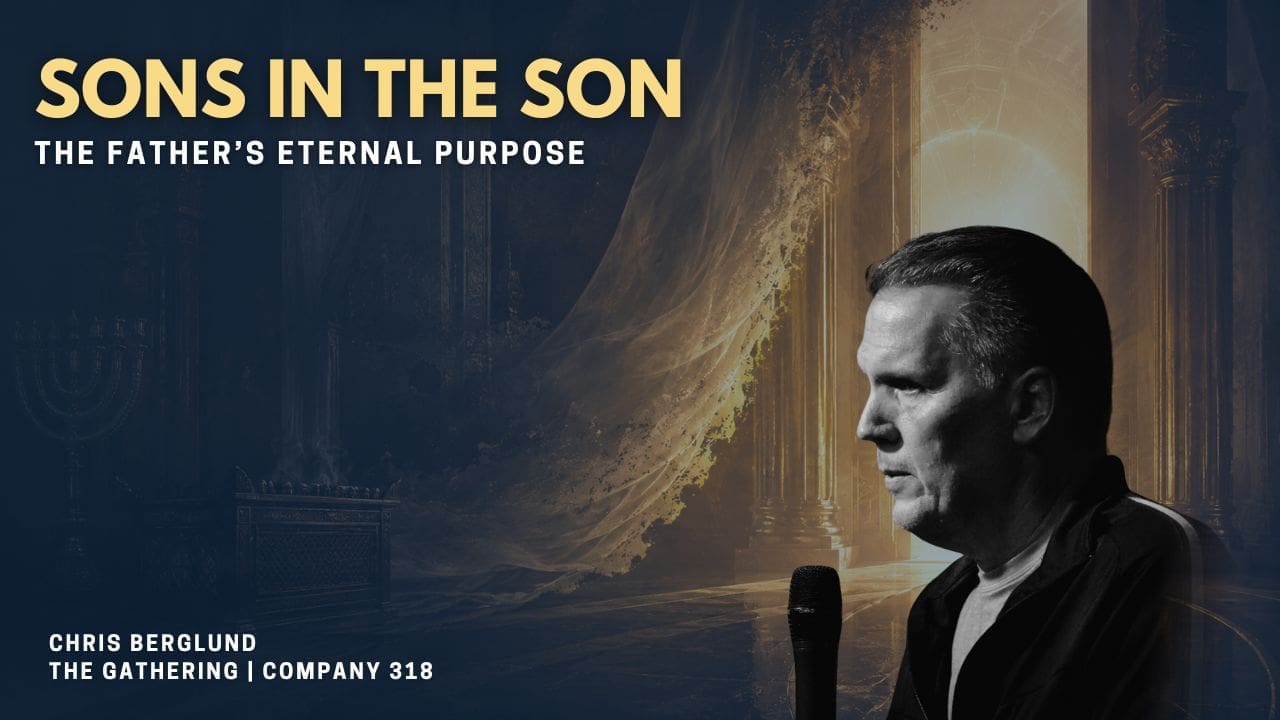
Watch the full teaching, “Sons in the Son: The Father’s Eternal Purpose,” with Chris Berglund.
Continue With Us
This message is part of the life being formed at The Gathering and through Company 318. Whether you are local to Colorado Springs or connecting with us from somewhere else, we would love to help you continue exploring the gospel of union, the finished work of Christ, and the Father’s purpose to form a people in His Son.
Plan Your Visit to The Gathering
Join us on Sunday in Colorado Springs and learn what to expect when you arrive.
Learn More About The Gathering
Discover our church, teaching, community life, and the ways we are learning to become a people who reveal Christ together.
Join Company 318 on Substack
Receive longer teachings, biblical reflections, prophetic insight, and invitations to connect with the wider Company 318 community.
Partner With The Gathering and Company 318
Your generosity helps us continue producing biblical teaching, strengthening our local church, forming the Company 318 community, and creating resources that help people live from the finished work of Jesus.
Sons in the Son: The Father’s Eternal Purpose
Leave a Reply Cancel reply

THE GATHERING
A local church and teaching community in Colorado Springs.
Sundays at 10:00 a.m.
720 Elkton Dr.
Colorado Springs, CO 80907
EXPLORE
LIFE TOGETHER
WIDER COMMUNITY
SUPPORT & CONTACT
About The Gathering
Leah Ramirez
Chris Berglund
Teaching
Reflections / Blog
Devotionals
Small Groups
Beholding and Prayer
The Grove
Planted Youth
Company 318
Behold School
Latest Teaching
YouTube
Facebook
Give
Contact Us
info@the-gathering.us
407-340-0204
@ 2026 The Gathering
What We Believe
Waic Up Call - Y.A.
The Vine - Kids