
March 9, 2026
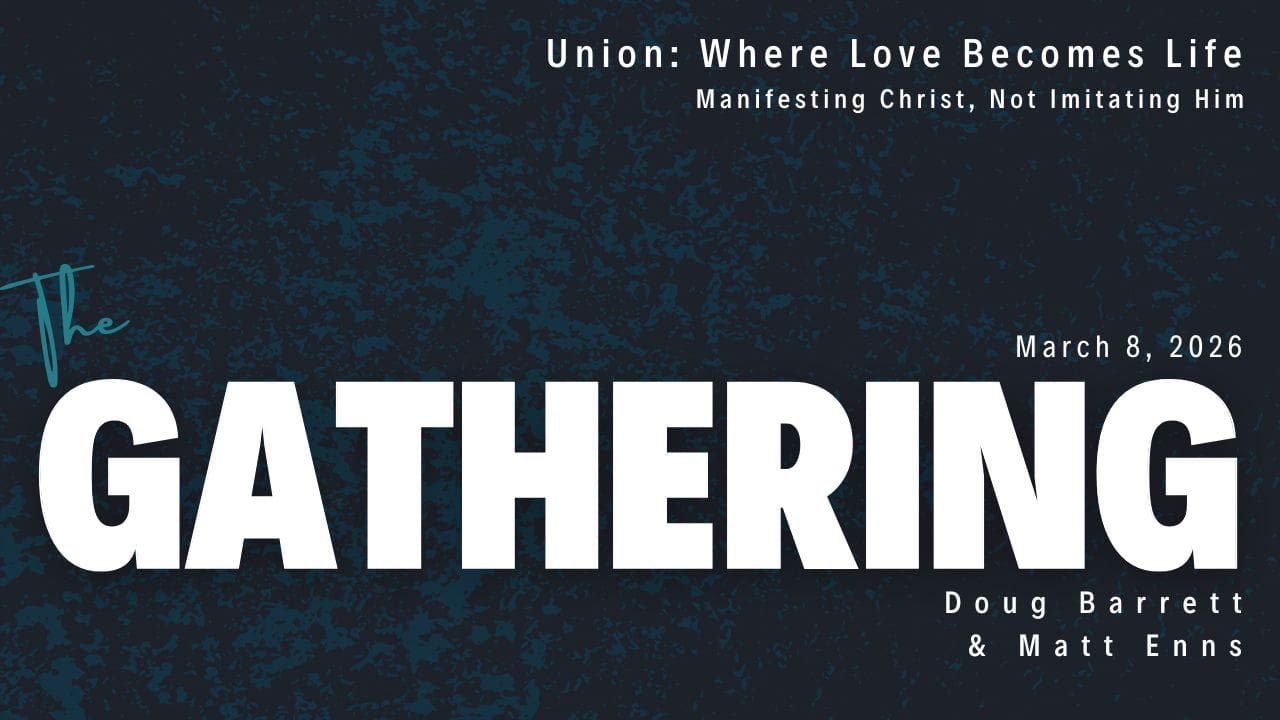
A Sunday Recap with Doug Barrett and Matt Enns at The Gathering in Colorado Springs
This past Sunday at The Gathering in Colorado Springs, we were honored to welcome Doug Barrett and Matt Enns, close friends of Chris Berglund, who shared a powerful message about union with Christ, the life of agape love, and what it means to truly surrender to the life of Jesus within us.
From beginning to end, the call was clear: the Christian life is not about platform, gifting, performance, or a polished outward ministry expression. It is about the surrendered life of Christ being formed within us until love becomes life.
Watch the full message here:
Union: Where Love Becomes Life | Doug Barrett & Matt Enns
Hiddenness Before Visibility
Chris opened the morning by honoring the hidden people who have marked his life. He reflected on friendships formed in obscurity, on praying with Lou Engle long before anyone knew his name, and on the quiet influence of men and women whose lives were shaped by a deep search for Jesus rather than by public recognition.
That became an important doorway into the message.
Both Matt and Doug carried the sense that God forms His people in hiddenness before He entrusts them with visibility. There is a life that pleases God before a microphone is ever handed over. There is a history in God that matters more than public fruit. There is a private conformity to Christ that must come before any outward expression of ministry.
That thread ran through everything that followed.
Matt Enns: The Life That Pleases God Is Formed in Secret
Matt shared first, beginning with Jesus’ baptism in Matthew 3:17:
“This is my beloved Son, with whom I am well pleased.”
He pointed out something simple but profound: the Father declared His pleasure over Jesus before Jesus had preached a sermon, performed a miracle, or stepped into public ministry.
Jesus had lived thirty hidden years, and it was there, in ordinary faithfulness, that the Father’s pleasure rested on Him.
Matt pressed this into the heart of the church. The center of Christianity is not found in a stage, a platform, or a public role. The real test of maturity is found in the hidden life—how we treat our spouse, our children, our neighbors, the person helping us, the person frustrating us, the people who cannot advance our calling.
He warned against quickly raising people into leadership without first seeing whether Christ has been formed in the private places. The Father Himself delighted in what had been proven in Jesus before the ministry ever began. That pattern still matters.
The message was not anti-ministry. It was a call to remember what ministry is meant to flow from: a life that has become pleasing to God in the secret place.
Mercy and Truth: The Nature of God Formed in a People
Matt then turned to the biblical language of mercy and truth—hesed and emet. He described these not merely as concepts, but as qualities of God Himself: loyal love, covenant mercy, steadfast truth.
He traced how these realities appear throughout Scripture and culminate in Jesus, who is the embodied union of mercy and truth. Christ does not merely teach these things. He is these things in flesh and blood.
And then comes the invitation: what Christ is by nature, He is forming in His people by grace.
This means the goal of the Christian life is not just correct doctrine or spiritual gifting. The goal is becoming a people in whom the loyal love and truth of God are made visible.
Matt made the point sharply: if we are not growing in mercy and truth, we are not displaying God rightly. Whatever else may be happening, the image is distorted if these qualities are absent.
Relationships as the Place of Formation
One of the strongest parts of Matt’s message was his insistence that relationships are one of God’s primary tools for forming His life in us.
He said, in essence, that every difficult relationship becomes an opportunity to discover where we are still limited in love, where we still resist truth, and where we still need the cross. The hard places reveal us. They show us where self still wants to rule. And in showing us, they become gifts—painful gifts perhaps, but gifts nonetheless—because they drive us back to Christ.
This is where the message became deeply practical.
Church is not only a place where we receive encouragement. It is also a place where perseverance is formed. The body of Christ becomes a context where selfishness is exposed, patience is tested, and the possibility of real transformation appears.
Matt did not present this as a burden. He presented it as the mercy of God.
Zoe: The Divine Life Christ Came to Give
From there, Matt moved to John 10:10 and the distinction between ordinary life and divine life.
When Jesus says He came that we might have life abundantly, Matt emphasized that the life being offered is not merely a better version of natural life. It is not simply emotional satisfaction, material blessing, or enhanced human experience. It is zoe—the life of God Himself.
That abundance is not the abundance of self getting what it wants. It is the abundance of God’s own life filling and shaping human beings.
And that life comes through humility.
Matt made the point that pride stops growth because pride assumes it has arrived. But humility remains open. Humility can still be taught. Humility can still be corrected. Humility can still receive more of Christ.
The infinite God does not meet us at the place where we think we have mastered love, truth, or maturity. He meets us at the place where we admit our need.
The Old Must Pass Away
In 2 Corinthians 5, Matt highlighted Paul’s language about no longer regarding anyone according to the flesh. This became another major anchor in the message.
The old man cannot be mixed with the new creation.
Old ways of seeing, old religious reflexes, old identities, old patterns of self-justification—these must be put away. The life of Christ cannot be fully manifested where the old is still being protected.
Matt said something deeply important: transformation often happens through trial. God allows us to come to the limits of ourselves so that the cross can do its work there. In the place where our own resources fail, resurrected life can begin to form.
That is not punishment. It is mercy.
Even loss of control can be part of that mercy. Matt observed that God often deals with our control issues by putting us in situations we cannot control. The discomfort is real, but it opens the door for surrender.
Are We Willing to Be Hidden Again?
One of the most searching questions Matt asked was whether we are willing to let God put our ministry, our gifting, or our sense of usefulness “on ice” if that is what He wants.
If Jesus pleased the Father before public ministry, then perhaps there are seasons when God calls us back into hiddenness so that what is formed in us is deeper, truer, and more enduring.
Can we trust Him there?
Can we return to the simplicity of being with Him, walking with Him, living well before Him, without demanding visible fruit or public affirmation?
Matt’s answer was clear: if God wants to reproduce His Son in us, then hiddenness is not a setback. It may be the very place where His pleasure rests most deeply.
Doug Barrett: The Way, the Truth, and the Life
After Matt shared, Doug Barrett built on the same foundation, but he did so by tracing a rich biblical pattern through the cross, the tabernacle, covenant, and the life of agape.
Beginning with John 14:6, Doug unfolded Jesus’ words:
“I am the way, and the truth, and the life. No one comes to the Father except through me.”
Doug connected this to the pattern of the tabernacle. The way is the cross. The truth is the Spirit’s illumination bringing us into agreement with Christ. The life is entrance into the fellowship of the Father.
The point was not symbolic complexity for its own sake. The point was simple and strong: there is no life of God manifested in us apart from the cross.
The old must be put away.
We do not come into divine life by self-improvement. We come through death and resurrection. Christ, in His mercy, puts away the old. The Spirit then shines the truth of who we are in Him. And from that surrendered place, the life of the Father begins to flow.
Agape Is Not Self-Generated
Doug’s central emphasis was agape.
He made clear that agape is not natural affection, personality warmth, or spiritual niceness. Agape is the love of God Himself, and it does not originate in self. It flows only through surrender.
Using 1 Corinthians 13, he showed that all gifting, all activity, and all sacrifice are empty if agape is absent. It is possible to do impressive religious things and still remain untouched in the deeper places where self rules.
Agape, he said, is not provoked. It seeks not its own. It does not keep score. It does not demand its rights.
That brought the message into very practical territory, especially in marriage and close relationships. Doug spoke candidly about disappointment, unmet needs, offense, and covenant. His point was not to shame anyone, but to expose how quickly self still wants to dominate even our most intimate relationships.
Where self reigns, agape is hindered.
Where the cross is embraced, agape begins to flow.
Mercy and Truth Meet in Christ
Doug returned again and again to the phrase “mercy and truth,” showing how it runs through Scripture and finds its fullness in Christ.
At the center of his message was this idea: mercy puts away the old, and truth reveals the new.
In mercy, Christ has dealt with what we were apart from Him. In truth, the Spirit reveals who we are now in the Son. When these meet together in us, the glory of God is manifested.
This is not abstract theology. It is the pathway into mature sonship.
Doug spoke of rootedness in the cross and agreement with the truth of our union with Christ. From that place, the river of divine life begins to flow. The Christian life is no longer driven by self-effort, but by participation in the life of Another.
The River Cannot Flow Where the Flesh Is Still Defended
Doug used vivid language to describe how the river of God is hindered when we refuse surrender.
The issue, he said, is not that Christ’s life is weak. The issue is that we dam up the flow through self-protection, self-assertion, resentment, and offense.
That image deeply connected with what Chris and Susan had been sharing in previous weeks. The river is not the problem. Our resistance is.
Doug drew on John 7, Psalm 46, and Isaiah 60 to show that God desires a people through whom His life can flow in fullness—a people who shine in dark times because they have yielded themselves wholly to Him.
The hope is not merely personal breakthrough. The hope is that Christ would be seen in a people.
A Response to the Word: Today Is the Day
After Doug and Matt finished sharing, Chris responded to the message and helped bring the moment into focus for our church family.
Before anything else, he made something very clear. For anyone hearing this message through the lens of past failure—especially divorce or painful relational history—there is no condemnation in Christ. The invitation to surrender is never an invitation into guilt, shame, or stigma. Whatever has happened in the past does not define who we are now. In Christ, we are free to fully belong to Him and to walk in the life He is offering.
At the same time, the word carried a deep sense of urgency.
The call of the Gospel is not merely a slow adjustment over time. Scripture says today is the day of salvation. The invitation before us is not to negotiate with the old life, but to lay it down and step into the life of Christ now.
As the church leaned into prayer, the message became even clearer. To refuse the life of Christ within us—to resist the agape of God and dam up the river of His love—is to settle for something hollow. It is to live and lead from something less than the life we were created for.
The language that surfaced was strong but honest: to reject the flow of Christ’s life is to drift toward a kind of worthless shepherding—a life that may still carry religious language but lacks the living current of the Son.
The call before us was not toward a better religious performance. It was toward real surrender.
What followed was a corporate cry of response. Hearts turned toward the Lord in repentance and faith—laying down the old man, surrendering false ambition, and asking the Lord to remove every place where we have dammed up the river of His life within us.
The prayer was simple but profound: that God would tune the heartstrings of His people until the song of Christ could be played clearly through our lives.
It was a holy moment. Not dramatic for the sake of drama, but deeply searching and deeply clear.
The invitation was unmistakable:
Not someday.
Not eventually.
Not after a long internal negotiation.
Today is the day.
The Invitation Before Us
This Sunday’s message was not mainly about ministry strategy, relationship advice, or personal improvement. It was about the centrality of the cross and the reality of union with Christ.
Matt called us to remember that what pleases God is often formed in hiddenness before it is ever seen in public.
Doug called us to the cross as the only place where agape can truly flow.
And together, the message landed with a single invitation: let the old be put away, receive the truth of who you are in Christ, and yield to the life of God until love becomes life.
That is the call.
Not performance.
Not striving.
Not self-protection.
Not image management.
But surrender.
Not pretending to be loving, but Christ becoming love in us.
Reflection Questions
Here are a few questions to pray through personally or discuss with others:
- Where am I still measuring spiritual maturity by visibility, gifting, or outward usefulness rather than by hidden faithfulness?
- What relationships in my life are currently exposing areas where self is still resisting the life of Christ?
- Is there a place where I am still defending the old man instead of agreeing with the cross?
- Where have I been asking God to bless self-preservation rather than surrender?
- What would it look like for me to trust God in hiddenness without needing public affirmation?
- Are there places in my marriage, family, friendships, or church life where I have “dammed up the river” through offense, resentment, fear, or control?
- What does it mean for me, in this season, to say yes to mercy and truth meeting in my life?
- If today really is the day of salvation in this area, what is the Holy Spirit asking me to lay down now?
Explore Company 318
Company 318 is a growing national network centered on prayer, communion, and life in union with Christ. Join others across the country who are saying yes to deeper formation in the Gospel.
https://company318.com
Visit The Gathering (Colorado Springs)
The Gathering is a Christ-centered church in Colorado Springs committed to the Gospel, prayer, and growing together in the life of Christ.
https://the-gathering.us
Union: Where Love Becomes Life
Leave a Reply Cancel reply

THE GATHERING
A local church and teaching community in Colorado Springs.
Sundays at 10:00 a.m.
720 Elkton Dr.
Colorado Springs, CO 80907
EXPLORE
LIFE TOGETHER
WIDER COMMUNITY
SUPPORT & CONTACT
About The Gathering
Leah Ramirez
Chris Berglund
Teaching
Reflections / Blog
Devotionals
Small Groups
Beholding and Prayer
The Grove
Planted Youth
Company 318
Behold School
Latest Teaching
YouTube
Facebook
Give
Contact Us
info@the-gathering.us
407-340-0204
@ 2026 The Gathering
What We Believe
Waic Up Call - Y.A.
The Vine - Kids
https://shorturl.fm/pkCrH