
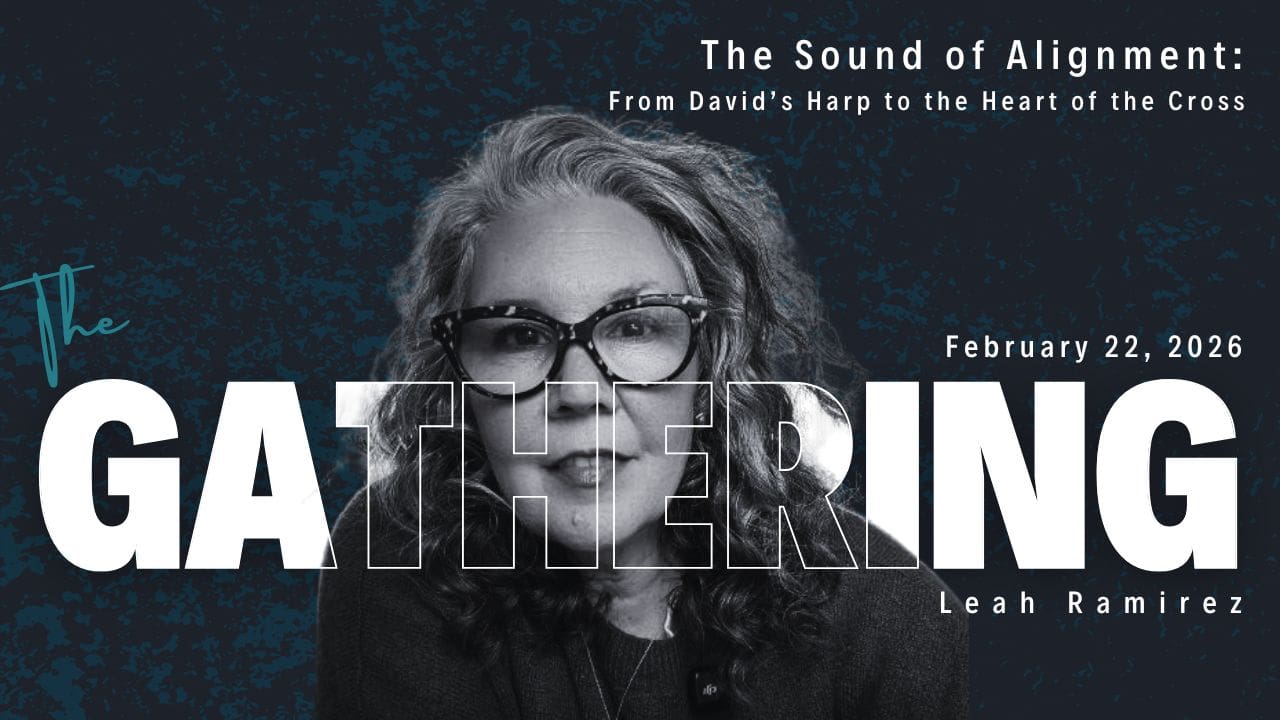
February 23, 2026
Rewatch + Share
If you missed Sunday (or want to sit with it again), here’s the replay:
https://www.youtube.com/live/bFXhU83guQc?si=-1VMRSVZq1pggoJ2
A weekend of intensity—and an invitation to come into tune
If you were with us because of the conference weekend, I want to say it again: you have a home here. There was a lot in the atmosphere this weekend—big themes, big questions, and (if you felt it) a kind of spiritual “static.” That’s often what happens when we touch matters of Israel, end-times frameworks, and anything that forces us to wrestle honestly with God.
So we began the only way we know how: asking the Lord to clear the atmosphere, settle our hearts, and let us hear His sound again.
Because alignment starts there.
Chris Berglund’s Harp Dream: intimacy before declaration
Chris shared a dream that has stayed with us because it feels like a word not only for “many,” but for this house.
In the dream, David is first seen in a field—hidden, prepared, tuning a harp beside a stream. The tension matters: too tight and the strings break; too loose and the sound loses clarity. Then the scene shifts: David is in the palace bedroom playing for a tormented Saul, and the dream makes something clear—no trumpets, shofars, or wind instruments were allowed in that bedroom. It was a room of intimacy. And David’s harp was shaped like a heart on one side and a bowl on the other—heart and incense, affection and intercession.
And here’s the weight of it: the frequency of David’s harp wasn’t just rising upward in worship—it was also moving horizontally, governing the chaos in Saul’s mind. In other words, government was being released from intimacy.
This is the order the dream carries:
harp before trumpet
bedroom before battlefield
affection before authority
And I’ve felt the fear of the Lord on this, because it confronts us with a choice:
What kind of room do we want to be as a church? A living room? A green room? A busy room? Or a bedroom chamber—a people who say yes to covenant closeness?
When heaven tunes a human heart
During Beholding on Wednesday night, I found myself inside the dream—by the stream—asking a simple question: How do I tune my strings? Not too loose. Not too tight. The “relief” of removing tension can feel like comfort… but sometimes God is not inviting comfort. He is inviting alignment.
And in that place, I sensed the Lord touch my heartstrings—like my heart became a harp—and He began to play. And then (this part was staggering) it felt like face-to-face resonance—His heart and mine plucking the strings of one another. I don’t have tidy language for it. But I know the invitation was union—heart-to-heart, frequency-to-frequency.
Stillness isn’t nothing—it’s agreement
This is where something Connie shared helped me find words. She talked about how an orchestra tunes—and how, when it truly comes into tune, a stillness forms.
When I went looking, I found language that arrested me: when instruments are close-but-not-aligned, the room feels unsettled because the vibrations compete. But when the orchestra comes into tune, nothing stops vibrating—what changes is that the frequencies begin to agree. The interference disappears. The competing waves become coherent. And what we interpret as stillness is actually perfect agreement.
So hear me: Beholding isn’t “doing nothing.”
It’s letting the frequency of our hearts come into agreement with the frequency of His heart. It’s coming into tune—until striving settles, chaos loses its grip, and rest begins to feel possible again.
This is why I keep saying: I believe there’s an inheritance for us in this season called Sabbath rest.
Not a passive life.
A life that moves from alignment rather than anxiety.
Beholding the Cross: whose wrath was on display?
And then we moved into the center: the cross.
Because if we misunderstand what happened there, we’ll misunderstand God Himself—and we’ll carry misalignment into everything: how we relate to Scripture, how we walk out covenant, how we stand with nations, how we treat one another.
So I asked the question plainly:
Was the cross a demonstration of God’s wrath… or ours?
We looked through a lens the New Testament repeats clearly:
Jesus was betrayed into the hands of sinners.
He endured hostility from sinners.
He was condemned, mocked, scourged, and crucified by human violence.
And then we went to the cry itself:
Matthew 27
Jesus cries, “My God, my God, why have you forsaken me?”
And the veil is torn from top to bottom. The earth shakes. Tombs open. Resurrection breaks in.
Many have been taught this is God turning His face away from His Son.
But I do not believe that is what the gospel is showing us.
I believe Jesus is identifying with the human cry—our cry—our confusion, our lostness, our “Where are you, God?” And then He points us to the psalm He is quoting, because He wants the song to finish in our minds.
Psalm 22 doesn’t end in abandonment
Jesus begins Psalm 22 on the cross so we will remember where it ends:
Psalm 22
The suffering is real. The mocking is real. The piercing is real.
But then the revelation breaks open:
“For He has not despised or abhorred the affliction of the afflicted,
and He has not hidden His face from him,
but has heard, when he cried to Him.”
Beloved, the psalm says the opposite of “God turned away.”
It declares: He has not hidden His face.
And this aligns with the gospel announcement Paul makes:
2 Corinthians 5
“In Christ God was reconciling the world to Himself, not counting their trespasses against them…”
So the cross is not God needing to be convinced to love us.
The cross is God revealing His love—entering our death, bearing our violence, absorbing our wrath, and tearing the veil that kept humanity trapped in separation-thinking.
“I am a worm…” and the crimson mystery
Then we hit the line that has been weaponized against people for far too long:
“But I am a worm and not a man…” (Psalm 22:6)
Some have preached that verse as humiliation theology: “You’re lower than worms.”
But Psalm 22 uses a specific word—tola’ath—connected to crimson/scarlet dye.
And the picture is astonishing: the crimson worm attaches to wood, forms a protective shell, gives its life so its young can live, stains the wood crimson, and then (in the description shared) transitions into a white, wax-like substance that flakes down like snow—echoing Isaiah’s language: scarlet made white as snow.
I’m not presenting this as cute trivia.
I’m saying: creation has been seeded with witnesses.
The Lamb was slain before the foundation of the world, and the world is full of signposts that whisper His story.
And if anything, this should renew our minds: Jesus is not calling you worthless. He is revealing that even our most misread places can be gathered back into crimson mercy—into gospel clarity.
A simple practice for this week: 10 minutes of alignment
If you don’t know where to begin, begin here:
- Sit somewhere quiet.
- Place your hand over your heart.
- Pray: “Retune me, God.”
- Then do something that feels almost too small: behold Him.
- behold Christ loving you
- behold Christ crucified
- behold the veil torn
- behold the indwelling Christ
Stillness may come.
Not because nothing is happening—
but because agreement is happening.
Join the conversation (Band)
At the end of our gathering, I asked for help from those who are gifted at facilitating conversation online. If that’s you—please help us build the kind of space where people can process vulnerably and safely. Start the thread. Ask the question. Share what you’re hearing. Sometimes leadership looks like being the first one brave enough to be honest.
(You can find our community in the Band app—jump in and start a conversation.)
Links to stay connected
The Gathering (Colorado Springs): https://the-gathering.us/
Re-Found Devotional: https://the-gathering.us/re-found-devotional
Company 318 (Prayer + Covenant Network): https://company318.com/
Company 318 Substack: https://company318.substack.com/
Closing blessing
May the Lord tune our hearts until the competing frequencies in us settle into agreement.
May we become a harp-before-trumpet people—intimacy before declaration.
And may the gospel land so deeply in us that rest becomes our native language.
With love,
Leah
The Sound of Alignment: David’s Harp and the Heart of the Cross
Leave a Reply Cancel reply

THE GATHERING
A local church and teaching community in Colorado Springs.
Sundays at 10:00 a.m.
720 Elkton Dr.
Colorado Springs, CO 80907
EXPLORE
LIFE TOGETHER
WIDER COMMUNITY
SUPPORT & CONTACT
About The Gathering
Leah Ramirez
Chris Berglund
Teaching
Reflections / Blog
Devotionals
Small Groups
Beholding and Prayer
The Grove
Planted Youth
Company 318
Behold School
Latest Teaching
YouTube
Facebook
Give
Contact Us
info@the-gathering.us
407-340-0204
@ 2026 The Gathering
What We Believe
Waic Up Call - Y.A.
The Vine - Kids
https://shorturl.fm/p5dRH