
January 26, 2026
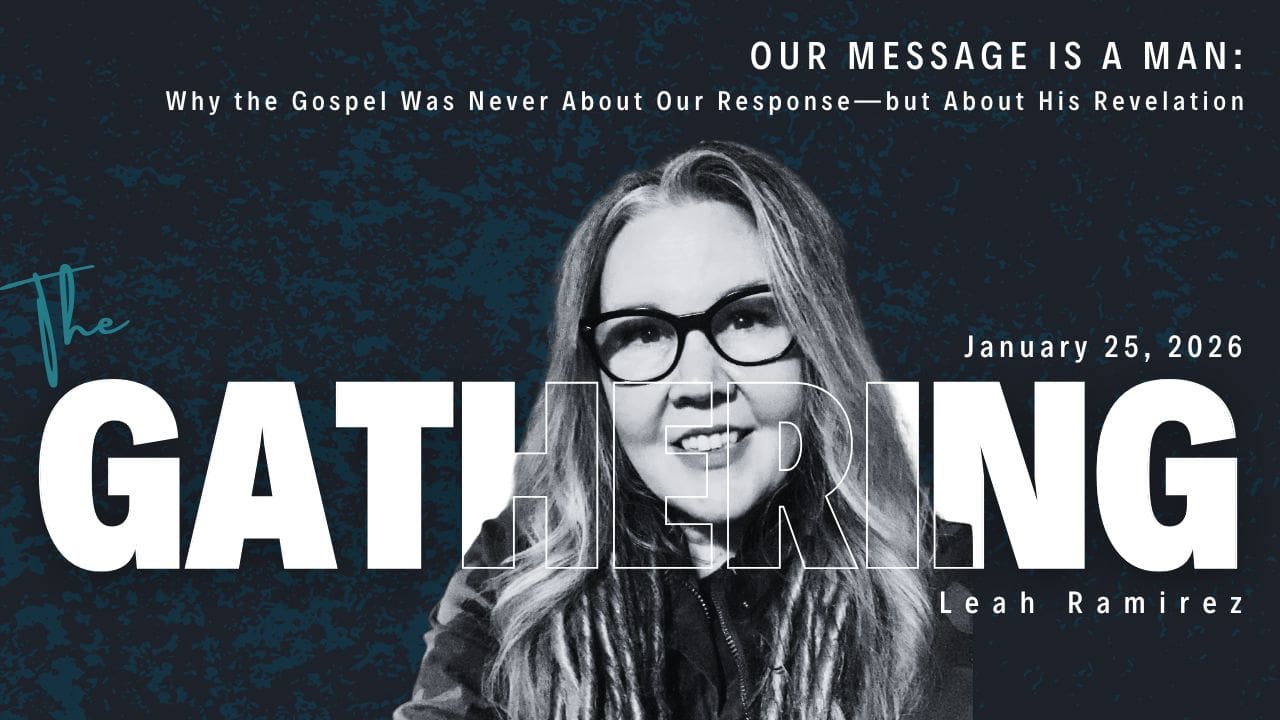
Why the Gospel Was Never About Our Response, But His Revelation
Before we opened the Word, we prayed something simple—and weighty:
Put your hand on your heart. Sift us, God. Align us with Your heart. Teach us to see the way You see, and to speak the way You speak. Free us from political spirits, from religious spirits, from every lens that distorts the Gospel.
There’s a kind of prayer that doesn’t ask for information—it asks for alignment. Not “give me my next step,” but “heal my sight.”
Because the crisis in the church is not primarily a discipline crisis. It’s a revelation crisis.
The Gospel is His part
I titled this message Our Message Is a Man because I want to split hairs that have been tangled for far too long.
So often what gets preached as “the gospel” is actually the call to respond to the gospel.
And yes—there is a response. There’s repentance. There’s turning. There’s surrender. There’s obedience. There’s transformation. But here’s the problem:
You cannot respond wholeheartedly to Someone you have not truly seen.
We can perform disciplines that those who have seen found helpful in their pursuit, but a heart response comes when our hearts are enlightened—and not before.
When we confuse our part with His part, we get into trouble. We begin preaching behavior as foundation. We preach discipline as if it saves. We preach our ladder, our map, our formula.
But the Gospel is not our ladder.
The Gospel is a Person.
Jesus came to reveal the Father’s affections toward us. That is the Good News. Not an abstract idea. Not a theological transaction. A Man—God in human flesh—showing us what God is like.
A different way of hearing: the inflection of God
This week something happened to me in Acts 2.
I’ve read the passage so many times, and I’ve always heard a particular tone in it—especially when Peter says:
“This Jesus… you crucified and killed…” (Acts 2:23)
I’ve heard it like accusation. Like a pointed finger. Like “You did it, and God is furious.”
But in prayer, the inflection changed.
Same words. Different tone.
I could hear Peter imploring, not condemning—almost as if God Himself were making His appeal through Peter.
And it hit me: we can say the right words with the wrong inflection. We can quote Scripture while carrying an inherited tone—an old religious frequency—that makes God sound harsh when He’s not.
Some of the verses that have been weaponized against people and against the church—God is saying, That is not My inflection.
The cross was not God’s violence on display
Here’s where the tone shift becomes everything.
If we misunderstand God, we will misread the cross.
And when we misread the cross, we will build a whole spirituality around self-protection, fear, accusation, and control.
But what was on display at the cross was not the violence of God toward His Son.
What was on display was the violence of humanity toward God.
God did not come with a weapon. He came with Himself. He did not arrive to crush us. He arrived to rescue us from the delusion that He is like us in our rage.
God was in Christ reconciling the world to Himself.
The Father and the Son were not at odds. This was not divine retaliation. This was divine self-giving.
And right in the center of humanity’s blindness, Jesus prays:
“Father, forgive them, for they know not what they do.” (Luke 23:34)
He meant it.
The cross does something painful and healing at the same time:
To glimpse the Son is to glimpse our own violence—our accusation, our blindness, our grasping.
Just like Isaiah: “I saw the Lord… and immediately I saw myself.”
The revelation of God unveils us. Not to shame us—to heal us.
Religion is defending an interpretation of God at all costs
I’ve been thinking about what we mean when we say “religious spirit.”
Here’s a working definition:
Religion is the fierce defense of an interpretation of God—especially an interpretation that keeps us in control.
They killed Jesus in their zeal to protect their interpretation of the Father.
And if we’re honest, this same dynamic still works through us: when we believe God is an exactor, we will become exacting. When we believe God is violent, we will become violent (even if our violence is religious and clean-looking).
But when the Father is revealed in Jesus—kind, gentle, patient, long-suffering—something in the heart softens. The nervous system exhales. The eyes clear.
I am convinced: if we could declare the goodness of God as He truly is, people would run toward Him.
Identity: Jesus did not entrust Himself to us
This is one of the strongest threads in the message: Jesus’ identity was rooted in the Father—not in the opinions of man.
“Jesus… did not entrust himself to them… for he himself knew what was in man.” (John 2:24–25)
Jesus was not stabilized by approval. He was not destabilized by misunderstanding.
John 6 is a perfect example: many disciples walk away. And Jesus does not scramble to manage the moment. He doesn’t explain Himself to preserve the crowd.
He simply turns to the twelve and says:
“Do you want to go away as well?” (John 6:67)
That’s not detachment. That’s rootedness.
And this is our call too.
Because we are entering days where faithfulness will not always win the popularity vote. If our identity is tethered to being understood, affirmed, and celebrated, we will not be able to carry the ministry of Christ.
“He loved them to the end” — in the context of betrayal
John 13 is the chapter of betrayal—Judas and Peter both fail in the same neighborhood of Scripture.
And what does John say right at the threshold?
“Having loved his own who were in the world, he loved them to the end.” (John 13:1)
The love of Jesus is not rooted in our ability to reciprocate.
And then comes the line that holds the whole pattern together:
“Jesus, knowing that the Father had given all things into his hands, and that he had come from God and was going back to God…” (John 13:3)
Knowing fuels pouring.
We could preach six weeks on being better servants, but without this revelation—what the Father has placed into our hands, where we came from, and where we’re going—we will turn service into striving.
The towel is not produced by willpower.
The towel is produced by identity.
Hesed and a community with open hearts
This message wasn’t only about theology—it was about formation.
We’re being called to hesed—deep covenant love, a joining of lives, not superficial friendliness. Love first. Not testing people first. Not making them jump through hoops to earn nearness.
And we need to say it plainly: that kind of love will be tested.
There will be misunderstanding. There will be accusation. There will be moments where every self-protective instinct in you wants to close the heart and manage the risk.
But the invitation of Jesus is costly and clear:
Open wide.
Not because people are safe, but because He is.
Trust doesn’t start with people. Trust starts with God: Whatever comes, You will be with me.
Apostolic application: the mark is endurance, not hype
If we want to talk about apostles and prophets with any integrity, we have to look at Paul.
2 Corinthians 6 does not describe platform-building. It describes a life that has been sifted into love:
Afflictions. Hardships. Calamities. Beatings. Sleepless nights. Hunger. Slander and praise.
And then Paul says something that sounds like Jesus:
“Our heart is wide open… widen your hearts also.” (2 Cor. 6:11–13)
This is the cross in human form.
A people whose love is not controlled by response.
The mandate: no creature should be turned away
Toward the end, we read a line that feels like a bell in the soul:
No creature should be turned away.
That is not permission to remain in delusion. It is a declaration about the Father’s heart.
They can walk away. Free will is real. But they will not be turned away.
And if Christ lives in us, we won’t either.
The Merton prayer: honesty as worship
We closed with Thomas Merton’s prayer—not because it’s poetic, but because it’s true:
I don’t know where I’m going. I don’t see the road. I don’t even fully know myself. But I believe the desire to please You does please You.
There is a kind of prophetic bravado that performs certainty. But God is leading us into something more valuable than certainty: trust.
And if you feel like your life has been full of uncertainty lately, maybe you’re not failing. Maybe you’re being trained in something rare: resting in God without needing to control the outcome.
A simple invitation
If you’re in Colorado Springs and you’re looking for a community centered on Jesus—His nature, His heart, His Gospel—you’re welcome here.
And if you’re longing for deeper connection in prayer, union, and covenant friendship across regions, Company 318 is building a network for that too.
Watch the message
YouTube link: https://www.youtube.com/live/jUBYgmss40k?si=T5vWskIAz1J_c4F-
Connect with us
- The Gathering (Colorado Springs): https://the-gathering.us
- Company 318: https://company318.com
- Company 318 Substack: https://company318.substack.com/
Our Message Is a Man
Leave a Reply Cancel reply

THE GATHERING
A local church and teaching community in Colorado Springs.
Sundays at 10:00 a.m.
720 Elkton Dr.
Colorado Springs, CO 80907
EXPLORE
LIFE TOGETHER
WIDER COMMUNITY
SUPPORT & CONTACT
About The Gathering
Leah Ramirez
Chris Berglund
Teaching
Reflections / Blog
Devotionals
Small Groups
Beholding and Prayer
The Grove
Planted Youth
Company 318
Behold School
Latest Teaching
YouTube
Facebook
Give
Contact Us
info@the-gathering.us
407-340-0204
@ 2026 The Gathering
What We Believe
Waic Up Call - Y.A.
The Vine - Kids